
The Complete Guide to Low Libido: Causes, Treatment, and When to Seek Help. Sex therapy that supports in scottsdale, AZ
By Holly Nelson, LPC | EMDR Certified Therapist | AASECT Certified Sex Therapist (In Progress)
What Is Low Libido?
Low libido is a decrease in sexual desire that feels distressing to you or is causing problems in your relationship. While everyone experiences changes in their sex drive throughout life, persistent low libido can affect self-esteem, emotional intimacy, and overall well-being.
There is no "normal" level of sexual desire. Some people naturally have a higher sex drive, while others have little interest in sex and feel completely satisfied. Low libido only becomes a concern when it represents a change from your usual level of desire or causes personal or relationship distress.
The good news is that low libido is common and treatable. Physical health, hormones, medications, stress, anxiety, relationship dynamics, life transitions, past trauma, and many other factors can influence it. Understanding the cause is the first step toward finding the right treatment.
This guide provides an evidence-based overview of low libido, including common causes, medical conditions that should be ruled out, treatment options, and practical steps you can take to improve your sexual well-being.
Quick Facts About Low Libido
• Low libido is one of the most common sexual concerns experienced by both men and women.
• Sexual desire naturally changes throughout life due to stress, relationships, aging, pregnancy, parenting, illness, medications, and hormonal changes.
• Low libido can have physical, psychological, relational, or lifestyle causes—and often involves more than one factor.
• Medical conditions such as thyroid disorders, diabetes, chronic pain, low testosterone, and hormonal changes can contribute to reduced sexual desire.
• Anxiety, depression, trauma, relationship conflict, burnout, and chronic stress can also decrease sexual interest.
• Effective treatment depends on identifying the underlying cause rather than trying a one-size-fits-all solution.
• A healthcare provider can help rule out medical causes, while a certified sex therapist can help address psychological, relational, and emotional contributors.
Who This Guide Is For
This guide is designed for:
Individuals who have noticed a decrease in their sex drive.
Women experiencing changes in libido due to hormones, stress, pregnancy, postpartum, or menopause.
Individuals wondering whether low libido is physical, psychological, or both.
Anyone looking for evidence-based information about improving sexual desire.
What You'll Learn
By the end of this guide, you'll understand:
What low libido is—and what it isn't.
Common medical, psychological, and relationship causes.
When low libido is considered normal.
When you should see a medical provider.
When sex therapy may help.
Evidence-based treatments for low libido.
Practical strategies for improving intimacy and desire.
Frequently asked questions about sex drive.
Medical Disclaimer
This guide is intended for educational purposes only and should not replace individualized medical or mental health care. If you're experiencing a sudden change in sexual desire, painful sex, erectile difficulties, hormonal concerns, or other symptoms affecting your sexual health, consult a qualified healthcare provider for a medical evaluation. If emotional, relational, or psychological factors are contributing to your concerns, working with a certified sex therapist may also be beneficial.
Table of Contents
Part 1: Understanding Low Libido
What Is Low Libido?
Signs Your Libido May Be Lower Than Usual
Low Libido vs. Sexual Dysfunction: What's the Difference?
Part 2: Why Low Libido Happens
The Most Common Causes of Low Libido
Medical Causes of Low Libido
Mental Health and Low Libido
Relationship Factors That Affect Desire
How Stress, Burnout, and Life Changes Affect Libido
Medications That Can Lower Sex Drive
Hormones and Low Libido
How Trauma Can Affect Sexual Desire
Lifestyle Factors That Influence Libido
Part 3: Low Libido Across Different Populations
Low Libido in Women
Low Libido in Men
Low Libido During Pregnancy and After Childbirth
Low Libido During Perimenopause and Menopause
Low Libido and Aging
Part 4: Diagnosis and Treatment
How Low Libido Is Diagnosed
When Should You See a Medical Provider?
What Medical Tests Might Be Recommended?
When Should You See a Sex Therapist?
Evidence-Based Treatment Options for Low Libido
Can Medication Help?
Can Sex Therapy Help?
Can Couples Therapy Help?
Can Pelvic Floor Therapy Help?
Part 5: Improving Your Sex Life
Practical Ways to Increase Sexual Desire
How to Rebuild Intimacy in Your Relationship
Common Mistakes Couples Make When Desire Is Different
Part 6: Frequently Asked Questions
Can stress cause low libido?
Can anxiety cause low libido?
Can depression lower sex drive?
Can porn affect libido?
Does masturbation lower libido?
Can birth control lower libido?
Can antidepressants lower sex drive?
Can testosterone increase libido?
Is low libido permanent?
Can low libido be treated naturally?
Is it normal to have a lower sex drive than my partner?
When should I worry about low libido?
Part 7: Key Takeaways
Next Steps If You're Ready for Help
What Is Low Libido?
Low libido is a decrease in sexual desire or interest in sexual activity that causes personal distress, relationship concerns, or both. While everyone experiences natural changes in their sex drive throughout life, low libido becomes a concern when it represents a noticeable change from your usual level of desire or when it negatively affects your quality of life.
In other words, low libido isn't simply "not wanting sex enough." It's about whether your current level of sexual desire feels different than what is typical for you or creates challenges in your relationship or emotional well-being because libido is not one size fits all.
What Is Libido?
Libido, often called your sex drive or sexual desire, is your interest in sexual thoughts, activities, or intimacy. Libido exists on a spectrum. Some people naturally think about sex frequently, while others rarely do. Both experiences can be healthy.
Your libido is influenced by many factors, including:
Physical health
Hormones
Mental health
Stress
Sleep
Medications
Relationship satisfaction
Emotional intimacy
Past experiences
Cultural and religious beliefs
Life transitions
Rather than being controlled by a single hormone or personality trait, libido is the result of many biological, psychological, social, and relational factors working together.
Is There a "Normal" Sex Drive?
One of the most common questions people ask is:
"What is a normal libido?"
The truth is, there isn't one.
Some people naturally desire sex several times a week or multiple times a day, while others are content having sex once a month—or even less often. Asexual people may never think about or want sex at all. Neither one is right, wrong, good, or bad, healthy, or unhealthy.
Research has consistently shown that sexual desire varies widely from person to person and often changes throughout life. Stress, parenting, illness, aging, menopause, medications, pregnancy, relationship changes, and mental health can all influence your interest in sex.
Instead of asking whether your libido is "normal," consider asking:
Has my desire changed?
Does this change bother me?
Is it affecting my relationship?
Would I like my level of desire to be different?
These questions are often more helpful than comparing yourself to friends, social media, or what you believe you "should" want.
Low Libido Looks Different for Everyone
Low libido doesn't always mean having no interest in sex.
For some people, it may look like:
Rarely thinking about sex
Turning down sexual intimacy more often than before
Feeling indifferent about sex
Losing interest in initiating intimacy
Feeling emotionally disconnected from sexual experiences
Having difficulty becoming interested in sex even with a loving partner
For others, desire is still present but much less frequent than it once was.
You may also notice that your desire changes depending on the situation. For example, you may enjoy sexual experiences once they begin, but rarely feel spontaneous interest beforehand. Others may notice that desire only develops after emotional closeness, affectionate touch, or feeling relaxed.
These patterns can all be normal depending on the individual and the context.
When Is Low Libido a Problem?
Low libido becomes a concern when it causes distress.
That distress might include:
Feeling frustrated by a loss of sexual desire
Missing the level of intimacy you once had
Feeling guilty about disappointing your partner
Arguing about sex more frequently
Feeling disconnected in your relationship
Feeling pressure in your relationship to have more sex
Wondering if something is medically wrong
Feeling ashamed or "broken"
It's important to know that experiencing low libido does not mean there is something wrong with you. Sexual desire naturally changes throughout life, and there are many reasons those changes occur.
The goal isn't necessarily to increase your libido to match someone else's. The goal is to understand what's influencing your desire and decide whether you'd like support in making changes.
What Causes Low Libido?
Low libido rarely has a single cause.
Instead, it usually develops because several factors interact with one another.
For example:
A new parent may be sleep-deprived, overwhelmed, and recovering physically from childbirth.
Someone taking an antidepressant may notice medication side effects while also experiencing depression itself.
A person with chronic stress may have less energy for intimacy, leading to relationship tension that further decreases desire.
Someone who has experienced sexual trauma may feel emotionally unsafe during intimacy, making sexual desire more difficult to access.
Understanding these overlapping influences is one of the most important parts of identifying the right treatment.
Low Libido Is Treatable
One of the biggest myths about low libido is that nothing can be done.
In reality, many people experience meaningful improvements once the underlying causes are identified and addressed.
Treatment may involve:
Ruling out medical conditions with a healthcare provider.
Reviewing medications that may affect sexual desire.
Addressing stress, anxiety, depression, or burnout.
Improving communication and emotional intimacy with a partner.
Working with a certified sex therapist.
Making lifestyle changes that support overall physical and emotional health.
The best treatment depends on why your libido has changed—not simply on the fact that it has changed.
In the next section, we'll discuss one of the biggest misconceptions about sexual desire: the idea that there is a "normal" amount of sex everyone should want.

Is There a "Normal" Sex Drive?
One of the most common questions people ask is:
"Is my sex drive normal?"
The short answer is, there is no single "normal" sex drive.
People naturally vary in how often they think about sex, want sex, initiate intimacy, or masturbate. Some people desire sexual activity several times a week, while others are satisfied with sex once a month—or even less often. Neither experience is inherently healthier than the other.
What matters most is whether your level of sexual desire feels right for you and whether it supports the kind of relationship and life you want.
Sexual Desire Exists on a Spectrum
Sexual desire isn't something you either have or don't have. Instead, it exists on a spectrum.
Some people naturally have:
A high level of sexual desire
An average level of sexual desire
A lower level of sexual desire
Very little interest in sex
Each of these can be completely healthy.
For example, someone with a naturally low sex drive who feels happy, fulfilled, and isn't distressed by it does not necessarily have a sexual dysfunction.
On the other hand, someone who previously had a strong interest in sex but suddenly loses that desire may benefit from exploring what has changed.
Your Sex Drive Changes Throughout Life
Many people expect their libido to stay the same forever. In reality, sexual desire naturally changes over time.
Your sex drive may increase or decrease because of:
Stress
Parenthood
Pregnancy
Postpartum recovery
Perimenopause or menopause
Aging
Medical conditions
Medications
Anxiety or depression
Relationship changes
Sleep deprivation
Major life transitions
These changes are common and often temporary. A decrease in libido during a particularly stressful season of life does not necessarily mean something is wrong.
Stop Comparing Your Sex Drive to Other People
One of the biggest mistakes people make is comparing themselves to friends, social media, movies, or what they think they "should" want.
There is no research-based number for how often a healthy couple should have sex.
Some happy couples have sex several times a week. Others are perfectly satisfied with sex once or twice a month. What predicts relationship satisfaction is not simply how often couples have sex—it is whether both partners feel connected, respected, and able to communicate about their needs.
What If My Partner Has a Higher Sex Drive Than I Do?
Having different levels of sexual desire—often called a desire discrepancy—is one of the most common concerns couples experience.
A difference in libido does not automatically mean:
Your relationship is failing.
You are no longer attracted to your partner.
Someone is doing something wrong.
The relationship is incompatible.
The challenge is usually not that partners have different levels of desire. The challenge is learning how to communicate about those differences without blame, pressure, or shame.
Couples who approach desire differences with curiosity, empathy, and flexibility are often able to build satisfying intimate relationships even when their libidos don't perfectly match.
When Should You Be Concerned?
Rather than asking whether your sex drive is "normal," ask yourself these questions:
Has my sexual desire changed significantly from what is typical for me?
Am I bothered by this change?
Is it affecting my relationship or emotional well-being?
Do I avoid intimacy because of pain, anxiety, or fear?
Am I experiencing other symptoms, such as fatigue, erectile difficulties, vaginal dryness, pain during sex, or mood changes?
If you answered "yes" to one or more of these questions, it may be helpful to speak with a healthcare provider or a certified sex therapist to better understand what might be contributing to the change.
The Goal Isn't to Have More Desire—It's to Have the Right Desire for You
Many people come to therapy believing they need to increase their libido to match their partner's or to meet society's expectations.
In reality, healthy sexuality isn't measured by how often you want sex.
It's measured by whether your sexual relationship aligns with your values, your health, your relationship goals, and your own sense of well-being.
The goal isn't to chase a "normal" sex drive. The goal is to understand your unique pattern of desire, identify anything that may be interfering with it, and create a sex life that feels authentic and fulfilling for you.

Signs Your Libido May Be Lower Than Usual
Sexual desire naturally changes throughout life. A busy work season, caring for a newborn, recovering from an illness, or going through a stressful period can all temporarily affect your interest in sex.
However, if you've noticed a persistent decrease in your sexual desire that feels different from your usual pattern or is causing distress, it may be worth exploring further.
Remember, low libido isn't defined by how often you have sex. It's defined by whether your current level of desire is different from what feels normal for you and whether it's affecting your well-being or relationship.
Common Signs of Low Libido
You may be experiencing low libido if you notice one or more of the following:
You Rarely Think About Sex
You may find that sexual thoughts, fantasies, or curiosity about intimacy occur much less often than they used to—or not at all.
For some people, this change happens gradually. Others notice it suddenly after a major life event, medical diagnosis, medication change, or period of increased stress.
You Have Little Interest in Initiating Sex
If you previously enjoyed initiating intimacy but now rarely feel motivated to do so, this may be a sign that your sexual desire has changed.
It's important to remember that many people with low libido still love their partner deeply. A decrease in sexual desire is not necessarily a reflection of attraction or relationship satisfaction.
You Frequently Turn Down Sexual Intimacy
You may notice yourself saying "not tonight" more often than you used to.
Sometimes this happens because you're genuinely not interested in sex. Other times, you may avoid intimacy because you're exhausted, anxious, experiencing pain during sex, or worried about sexual performance.
Understanding why you're avoiding intimacy is often more important than simply noticing that you're avoiding it.
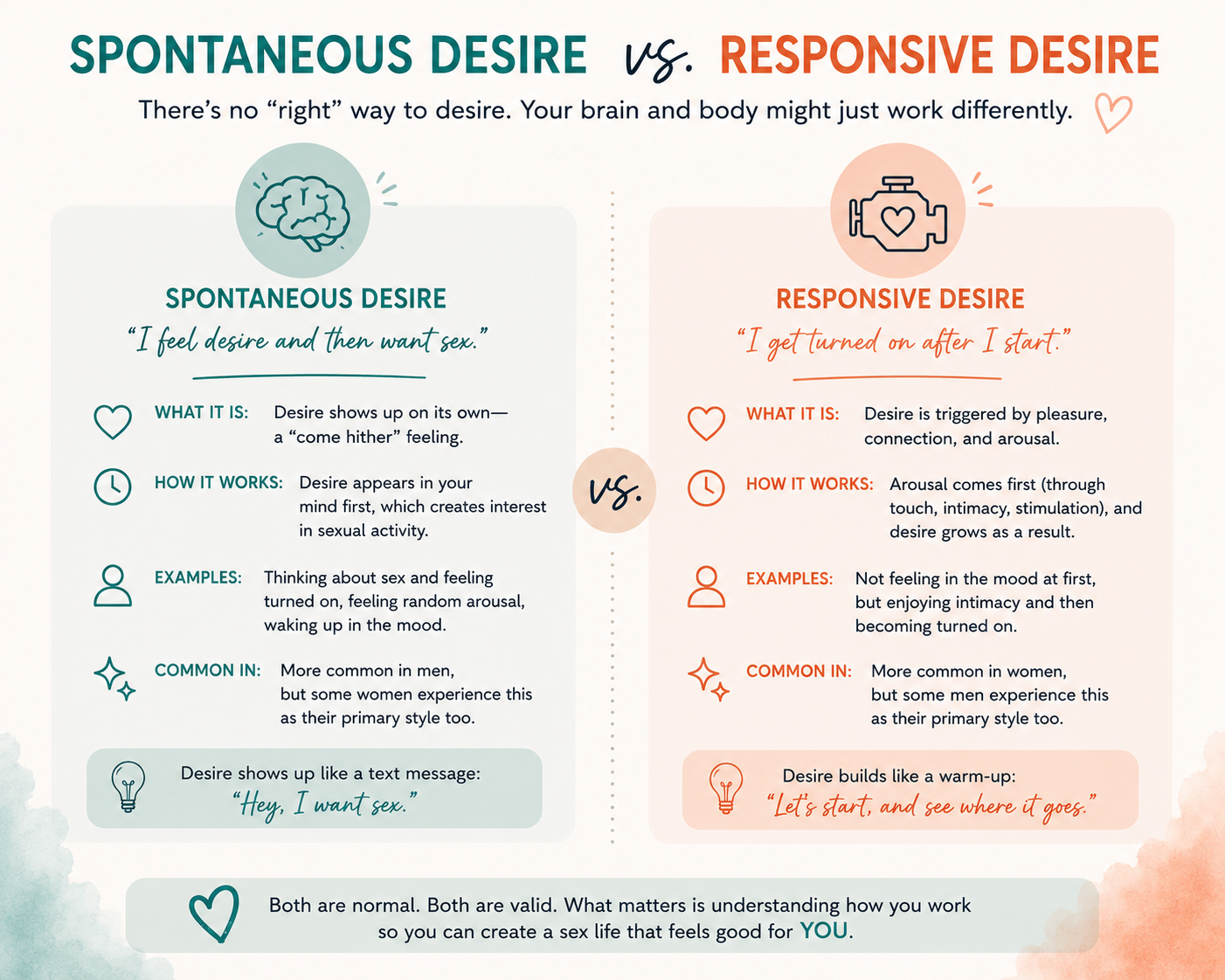
You Enjoy Sex Once It Starts—but Rarely Want It Beforehand
Many people worry that something is wrong because they don't experience spontaneous sexual desire.
In reality, many people experience responsive desire, meaning their interest in sex develops after affectionate touch, emotional closeness, or becoming physically aroused. You can read more about spontaneous and responsive desire in Emily Nagoski’s book: Come Together.
If you enjoy sexual experiences once they begin but rarely think about initiating them, this may be a normal pattern rather than a problem.
Sex Feels More Like a Chore Than Something You Look Forward To
If sexual intimacy begins to feel like another task on your to-do list instead of something enjoyable, it may be a sign that stress, burnout, relationship dynamics, or other factors are affecting your libido.
Many people describe feeling obligated to have sex rather than genuinely interested in it.
You Feel Distressed About Your Level of Desire
The most important sign isn't necessarily how often you want sex—it's how you feel about the change.
You may experience:
Frustration
Guilt
Shame
Confusion
Sadness
Worry about your relationship
Fear that something is medically wrong
These emotions are often what lead people to seek help.
Your Relationship Is Being Affected
Differences in sexual desire are one of the most common reasons couples seek sex therapy.
You may notice:
More arguments about sex
Feeling rejected or unwanted
Avoiding physical affection because you're worried it will lead to sex
Feeling emotionally disconnected
Difficulty talking openly about intimacy
A difference in desire doesn't mean your relationship is failing, but it does mean the two of you may benefit from learning new ways to communicate about intimacy.
What Low Libido Doesn't Always Look Like
Low libido doesn't always mean:
Never having sex
Never becoming aroused
Never reaching orgasm
Never finding your partner attractive
Many people with low libido still enjoy sex once it begins, experience orgasms, and feel attracted to their partner.
The challenge is often getting interested in sex in the first place.
When Should You Seek Help?
Consider talking with a healthcare provider or certified sex therapist if:
Your libido has changed significantly from what is typical for you.
The change has lasted for several months.
You're feeling distressed or frustrated by the change.
Your relationship is being affected.
You're experiencing pain during sex, erectile difficulties, vaginal dryness, or other physical symptoms.
You're wondering whether stress, trauma, medications, hormones, or a medical condition may be contributing.
You don't have to wait until your sex life is in crisis to seek support. Many people find that identifying the cause of low libido early can help prevent frustration, misunderstandings, and relationship strain.
Remember: Low Libido Is a Symptom, Not a Personal Failure
Low libido is not a character flaw, a lack of love, or proof that your relationship is doomed.
Instead, think of it as your mind and body communicating that something may need attention. Whether the cause is medical, emotional, relational, or lifestyle-related, understanding the "why" is the first step toward finding solutions that work for you.
Low Libido vs. Sexual Dysfunction: What's the Difference?
Many people use the terms low libido and sexual dysfunction interchangeably, but they are not the same thing.
Low libido refers specifically to a decrease in sexual desire or interest in sexual activity.
Sexual dysfunction is a broader term that includes problems with desire, arousal, orgasm, or pain during sexual activity.
Understanding the difference can help you identify what you're experiencing and determine what type of treatment may be most helpful.
What Is Low Libido?
Low libido is a decrease in your desire for sexual activity.
You may notice that you:
Think about sex less often.
Rarely initiate intimacy.
Feel less interested in sexual activity than you used to.
Don't feel motivated to seek out sexual experiences.
The key feature of low libido is reduced desire.
For some people, low libido develops gradually over time. For others, it begins suddenly after a medical diagnosis, starting a new medication, experiencing chronic stress, giving birth, entering menopause, or going through relationship changes.
What Is Sexual Dysfunction?
Sexual dysfunction is an umbrella term for ongoing problems that interfere with one or more parts of the sexual response cycle.
These concerns generally fall into four categories.
1. Desire Difficulties
This includes:
Loss of sexual interest
Little or no motivation for sexual activity
This is the focus of this guide.
2. Arousal Difficulties
Arousal is your body's physical response to sexual stimulation.
Examples include:
For women:
Difficulty becoming lubricated
Feeling mentally interested but physically unaroused
For men:
Erections that are less firm than usual
It's possible to want sex but still experience arousal difficulties.
Likewise, someone can have normal physical arousal but little desire for sex.
These are different concerns with different causes and treatments.
3. Orgasm Difficulties
Some people have difficulty reaching orgasm, experience delayed orgasm, or are unable to orgasm despite adequate stimulation.
This does not necessarily mean they have low libido.
Many people strongly desire sex but struggle with orgasm.
Others have little desire but experience orgasms without difficulty once sexual activity begins.
4. Sexual Pain
Pain during sex is another form of sexual dysfunction.
Examples include:
Pain with penetration
Burning sensations
Pelvic pain during intimacy
Pain after sex
When sex is painful, it's understandable that sexual desire may decrease over time. In these cases, low libido is often a response to the pain rather than the primary concern.
Can You Have More Than One Sexual Concern?
Yes.
In fact, many people experience more than one sexual concern at the same time.
For example:
Someone with painful sex may gradually lose interest in sexual activity because intimacy has become associated with discomfort.
A man experiencing erectile dysfunction may begin avoiding sex because of anxiety or fear of losing his erection, eventually noticing a decrease in desire.
Someone taking an antidepressant may experience lower libido, difficulty becoming aroused, and delayed orgasm simultaneously.
Because sexual functioning is interconnected, addressing one concern often improves others as well.
Why Identifying the Right Problem Matters
Different sexual concerns require different approaches.
For example:
Low libido may involve exploring hormones, medications, stress, relationship dynamics, or mental health.
Erectile dysfunction may require a medical evaluation, lifestyle changes, medication, or treatment for performance anxiety.
Pain during sex may benefit from a medical evaluation, pelvic floor physical therapy, or treatment for underlying conditions.
Orgasm difficulties may improve with education, changes in stimulation, medication adjustments, or sex therapy.
Understanding which part of the sexual response cycle is being affected helps guide the most appropriate treatment.
When Should You Seek Professional Help?
If changes in your sexual functioning are causing distress or affecting your relationship, it's a good idea to seek support.
Depending on your symptoms, this may include:
A primary care provider for an initial medical evaluation.
A gynecologist, urologist, or other specialist if hormonal or physical causes are suspected.
A pelvic floor physical therapist if pain or muscle dysfunction is contributing.
A certified sex therapist to address psychological, relational, emotional, or behavioral factors that may be affecting your sexual well-being.
Many sexual concerns are highly treatable. You don't have to figure out what's happening on your own, and seeking help early can often prevent frustration, shame, and relationship strain.
Key Takeaway
Low libido is one type of sexual dysfunction—but not all sexual dysfunction involves low libido.
Understanding the difference between desire, arousal, orgasm, and pain can help you better identify what you're experiencing and find treatment that addresses the underlying cause rather than just the symptoms.

Part 2: Why Low Libido Happens
The Most Common Causes of Low Libido
One of the biggest misconceptions about low libido is that there must be one clear cause.
In reality, sexual desire is influenced by your body, your mind, your relationships, and your environment. For most people, low libido develops because several factors are interacting at the same time.
For example, imagine someone who is sleeping poorly, feeling overwhelmed at work, taking an antidepressant, and struggling to connect emotionally with their partner. Any one of those factors could affect libido on its own, but together they can have an even greater impact.
That's why it's so important to understand the whole picture rather than looking for one simple explanation.
Low Libido Is Usually Multifactorial
Think of your libido like a garden.
Healthy desire grows when the conditions are right. It needs adequate physical health, emotional safety, energy, connection, and opportunity.
If several of those conditions change at once, it's completely understandable that sexual desire may decrease.
Rather than asking, "What's wrong with me?" a more helpful question is:
"What factors might be influencing my desire right now?"
The Most Common Causes of Low Libido
Medical Conditions
Your physical health plays an important role in sexual desire.
Many medical conditions can contribute to low libido, including:
Diabetes
Thyroid disorders
Heart disease
Chronic pain
Cancer and cancer treatments
Autoimmune disorders
Sleep disorders
Obesity
Hormonal conditions
Because low libido can sometimes be a symptom of an underlying medical condition, it's important to discuss any significant or sudden changes with your healthcare provider.
Hormonal Changes
Hormones help regulate many aspects of sexual functioning.
Changes in estrogen, testosterone, thyroid hormones, prolactin, and cortisol can all affect sexual desire.
Hormonal shifts commonly occur during:
Pregnancy
Postpartum
Breastfeeding
Perimenopause
Menopause
Aging
Not everyone experiencing hormonal changes will develop low libido, but they are an important piece of the puzzle.
Medications
Many commonly prescribed medications can affect sexual desire.
Examples include:
Some antidepressants (especially SSRIs and SNRIs)
Certain blood pressure medications
Hormonal birth control for some individuals
Opioid pain medications
Some anti-anxiety medications
Certain medications used to treat prostate conditions
Never stop taking a prescribed medication without speaking to your healthcare provider. In many cases, there are strategies that can help manage sexual side effects.
Stress and Burnout
When your brain is focused on survival, it often has less capacity for sexual desire.
Chronic stress can increase cortisol levels, reduce energy, interfere with sleep, and make it difficult to feel mentally present during intimacy.
Many people notice their libido decreases during periods of:
Work stress
Parenting young children
Financial concerns
Caregiving responsibilities
Major life transitions
Sometimes the problem isn't your libido—it's that your nervous system is exhausted.
Mental Health
Mental health and sexual health are closely connected.
Conditions such as:
Anxiety
Depression
Obsessive thoughts
Chronic stress
Grief
Unresolved past trauma
can all reduce sexual desire.
Mental health conditions may affect libido directly, while medications used to treat them can also contribute to changes in sexual functioning.
Relationship Factors
Desire often grows in relationships where people feel emotionally connected, respected, and safe.
Relationship challenges that may reduce libido include:
Frequent conflict
Poor communication
Feeling emotionally disconnected
Resentment
Lack of trust
Feeling criticized or unappreciated
Different expectations around sex
A decrease in desire doesn't necessarily mean you no longer love your partner. Sometimes it simply reflects that the relationship needs attention.
Trauma and Past Experiences
Past experiences can continue to influence sexual desire long after they occur.
Examples include:
Childhood abuse
Religious or cultural sexual shame
Negative sexual experiences
Body image concerns
Trauma doesn't affect everyone the same way, but for many people, feeling emotionally and physically safe is an important foundation for desire.
Lifestyle Factors
Everyday habits also influence sexual health.
These include:
Poor sleep
Limited physical activity
Alcohol use
Recreational drug use
Poor nutrition
Smoking weed
Chronic fatigue
Your body can't prioritize pleasure if it's working hard just to recover from exhaustion.
Life Transitions
Many normal life changes can temporarily affect libido.
Examples include:
Becoming a parent
Getting married
Divorce
Menopause
Retirement
Caring for aging parents
Starting a demanding new job
These transitions often bring changes in stress, identity, routines, and relationships—all of which can influence sexual desire.
More Than One Cause Is Normal
Many people hope they'll discover one simple explanation for their low libido.
In reality, most people have several contributing factors.
For example, someone may be:
Sleeping poorly because of a newborn.
Feeling disconnected from their partner.
Taking an antidepressant.
Experiencing hormonal changes after childbirth.
Addressing just one of these factors may help, but addressing several often leads to the greatest improvement.
Understanding the Cause Helps Guide Treatment
The good news is that low libido is often treatable.
The key isn't finding a quick fix—it's identifying the factors that are contributing to your unique experience.
In the following sections, we'll take a closer look at each of these causes so you can better understand what may be affecting your sexual desire and what evidence-based treatment options are available.

Medical Causes of Low Libido
If you've noticed a significant or sudden decrease in your sex drive, it's important to consider whether a medical condition may be contributing.
While stress, relationships, and mental health can all affect libido, your physical health plays an equally important role. In fact, low libido is sometimes one of the first signs that something else is happening in the body.
The good news is that many medical causes of low libido are treatable. Identifying and addressing an underlying health condition can often improve sexual desire and overall well-being.
Medical Conditions That Can Affect Libido
Many health conditions can contribute to a decrease in sexual desire, including:
Diabetes
Thyroid disorders (hypothyroidism or hyperthyroidism)
Heart disease and cardiovascular conditions
High blood pressure
Chronic pain conditions
Cancer and cancer treatments
Kidney disease
Liver disease
Autoimmune disorders
Neurological conditions such as multiple sclerosis or Parkinson's disease
Obesity
Chronic fatigue syndrome
Sleep disorders, including sleep apnea
These conditions can affect libido in different ways. Some reduce energy levels, others change hormone production, interfere with blood flow, increase inflammation, or make sexual activity physically uncomfortable.
Hormonal Changes and Low Libido
Hormones are often discussed when it comes to sexual desire—and for good reason.
Hormones help regulate many aspects of sexual functioning, including desire, arousal, mood, and energy.
Hormonal changes that may contribute to low libido include:
Low testosterone
Changes in estrogen levels
Perimenopause
Menopause
Pregnancy
Postpartum recovery
Breastfeeding
Thyroid hormone imbalances
Elevated prolactin levels
It's important to remember that hormones are just one piece of the puzzle. Many people with normal hormone levels still experience low libido, while others with hormonal changes continue to have a satisfying sex life.
Medications That May Lower Sex Drive
Sometimes the treatment for a medical condition—not the condition itself—can affect libido.
Medications commonly associated with decreased sexual desire include:
Certain antidepressants (especially SSRIs and SNRIs)
Some blood pressure medications
Hormonal birth control for some individuals
Opioid pain medications
Some anti-anxiety medications
Certain medications used to treat prostate conditions
Some medications used to treat seizures
If you think a medication is affecting your sex drive, don't stop taking it on your own. Instead, talk with your healthcare provider. In many cases, there may be alternative medications or strategies that can reduce sexual side effects while still effectively treating your condition.
Chronic Pain and Illness
Living with a chronic illness can affect much more than physical health.
Pain, fatigue, reduced mobility, frequent medical appointments, and emotional stress can all decrease sexual desire.
Conditions such as endometriosis, fibromyalgia, arthritis, migraines, inflammatory bowel disease, and chronic pelvic pain often affect intimacy because they make it more difficult to feel comfortable, energized, or emotionally available for sex.
Sometimes the biggest barrier isn't desire itself—it's that your body is asking for rest and healing.
Sleep and Energy Matter More Than You Think
Sleep is one of the most overlooked contributors to sexual health.
Poor sleep can:
Lower testosterone levels
Increase stress hormones
Reduce energy
Affect mood
Make it more difficult to become aroused
If you're consistently exhausted, your body is likely to prioritize recovery over reproduction.
For many people, improving sleep quality is an important part of improving libido.
When Should You See a Healthcare Provider?
It's a good idea to schedule a medical evaluation if:
Your libido changed suddenly without an obvious explanation.
Your decreased sex drive has lasted for several months.
You're experiencing fatigue, weight changes, or mood changes along with low libido.
You have pain during sex. (See a pelvic floor therapist)
You have erectile difficulties or vaginal dryness that are new or worsening.
You recently started a new medication and noticed changes in your sex drive.
You're concerned about hormone levels or another medical condition.
A healthcare provider can review your medical history, medications, symptoms, and determine whether additional testing is appropriate.
What Medical Tests Might Be Recommended?
Depending on your symptoms, your healthcare provider may recommend blood work or other testing to evaluate possible medical contributors to low libido.
This may include assessing:
Thyroid function
Blood sugar levels
Iron levels
Vitamin deficiencies
Hormone levels, when appropriate
Cardiovascular health
Other medical conditions based on your symptoms and health history
Not everyone with low libido needs extensive testing. Your healthcare provider will determine which evaluations are appropriate based on your individual situation.
Medical Health Is Only One Piece of the Puzzle
Finding a medical cause can provide important answers—but it's not the whole story.
Sexual desire is influenced by both physical and emotional health. Even when a medical condition is identified and treated, factors such as stress, relationship dynamics, anxiety, depression, trauma, and communication may still play an important role.
That's why the most effective treatment often takes a whole-person approach, addressing both the body and the emotional and relational aspects of sexuality.
In the next section, we'll explore how mental health—including stress, anxiety, depression, and emotional well-being—can significantly influence sexual desire.

Mental Health and Low Libido
Your brain is one of the most important sexual organ.
While hormones, blood flow, and physical health all influence sexual desire, your thoughts, emotions, stress levels, and nervous system also play a significant role. When your mental health is struggling, it's common for your libido to change as well.
For many people, low libido isn't a sign that they've stopped loving their partner or that something is "wrong" with them. Instead, it's often a signal that their mind and body are carrying more than they can comfortably manage.
How Mental Health Affects Sexual Desire
Sexual desire depends on your brain feeling safe, engaged, and available for pleasure.
When you're overwhelmed by stress, anxiety, depression, or trauma, your brain shifts its attention toward managing those challenges rather than seeking out intimacy.
Think about it this way:
If your mind is focused on paying bills, meeting work deadlines, caring for your children, or worrying about your health, it has less capacity to focus on sexual desire.
Your brain isn't failing—it's prioritizing survival over pleasure.
Stress and Low Libido
Stress is one of the most common causes of decreased sexual desire.
When you're under chronic stress, your body releases stress hormones like cortisol. Over time, elevated stress can:
Reduce energy levels
Make it difficult to relax
Disrupt sleep
Affect mood
Interfere with arousal
Reduce interest in sex
Many people notice that once stress decreases, their libido gradually returns.
If you've ever thought, "I'm just too exhausted to even think about sex," you're not alone.
Anxiety and Sexual Desire
Anxiety can affect libido in several ways.
Some people experience racing thoughts that make it difficult to stay present during intimacy. Others worry about their body, sexual performance, pregnancy, pain, or pleasing their partner.
When your mind is constantly scanning for potential problems, it's much harder to experience desire.
For some people, anxiety leads to avoiding intimacy altogether because sex begins to feel stressful instead of enjoyable.
Depression and Low Libido
Depression commonly affects sexual desire.
People experiencing depression may notice:
Less interest in activities they once enjoyed
Low energy
Emotional numbness
Difficulty experiencing pleasure
Reduced motivation for intimacy
Depression itself can lower libido, and some antidepressant medications may also contribute to changes in sexual desire, arousal, or orgasm.
If you've noticed changes in your sex drive after starting a new medication, talk with your healthcare provider before making any changes to your treatment.
Burnout and Emotional Exhaustion
Burnout isn't just feeling busy.
It's feeling emotionally, mentally, and physically depleted.
When you're constantly giving to work, family, or others, you may have very little energy left for yourself or your relationship.
Many people describe burnout as feeling like they have "nothing left to give."
In these moments, low libido is often less about sex and more about exhaustion.
Body Image and Self-Esteem
The way you feel about your body can influence the way you experience intimacy.
If you're preoccupied with thoughts such as:
"What does my partner think of my body?"
"I don't feel attractive."
"I'm worried they'll judge me."
it can become difficult to stay mentally present during sexual experiences.
Instead of focusing on pleasure, your attention shifts toward self-monitoring and self-criticism.
Improving body image isn't about changing your body—it's often about changing your relationship with your body.
Guilt, Shame, and Sexual Beliefs
Many people grow up receiving messages that sex is shameful, selfish, dirty, or something that should be avoided.
Even after entering a loving relationship, those early beliefs can continue to influence sexual desire.
Feelings of guilt or shame may make it difficult to:
Feel comfortable initiating sex
Enjoy sexual pleasure
Explore your sexuality
Communicate openly with a partner
Recognizing these messages is often the first step toward creating a healthier relationship with sexuality.
Trauma and the Nervous System
For individuals who have experienced sexual trauma or other forms of trauma, intimacy can sometimes activate the body's threat response.
Even when someone consciously wants to be close to their partner, the nervous system may respond with tension, numbness, anxiety, or avoidance.
This isn't a sign of weakness or a lack of love.
It's your nervous system doing what it learned to do to protect you.
With trauma-informed care, many people are able to rebuild a sense of safety, connection, and sexual well-being over time.
Mental Health Is Treatable—and So Is Low Libido
One of the most hopeful things about low libido is that many psychological contributors are highly treatable.
Addressing stress, anxiety, depression, trauma, burnout, relationship concerns, or negative beliefs about sexuality often leads to improvements in both emotional well-being and sexual desire.
Treatment might include:
Individual therapy
Stress management
Improving sleep and self-care
Mindfulness practices
Medication adjustments in collaboration with your healthcare provider
The goal isn't simply to increase your libido. It's to create the emotional, physical, and relational conditions where desire has the opportunity to grow.
Key Takeaway
Mental health and sexual health are deeply connected.
If your sex drive has changed during a period of stress, anxiety, depression, burnout, or emotional overwhelm, you're not alone—and it doesn't mean you're broken.
Your libido is often a reflection of your overall well-being. By caring for your mental health, you're also caring for your sexual health.

Relationship Factors That Affect Desire
It's common to assume that if your libido has decreased, the problem must be inside you.
But sexual desire doesn't exist in a vacuum.
The quality of your relationship can have a significant influence on your interest in sex. Feeling emotionally connected, respected, and safe often creates the conditions where desire can grow. On the other hand, ongoing conflict, resentment, or emotional distance can make it much harder to experience sexual interest.
This doesn't mean your relationship is "bad." It simply means that relationships and desire influence one another.
Emotional Connection Matters
For many people, emotional intimacy is closely connected to sexual intimacy.
Feeling emotionally connected may include:
Feeling heard and understood
Trusting your partner
Feeling appreciated
Laughing together
Spending quality time together
Feeling emotionally safe
When emotional connection increases, sexual desire often becomes easier to access.
Conflict and Resentment
Every couple experiences conflict.
The problem isn't whether disagreements happen—it's whether they get repaired.
When resentment builds over time, it can quietly affect desire.
You may notice thoughts such as:
"I don't feel appreciated."
"We're always arguing."
"I don't feel emotionally close anymore."
"I don't feel understood."
For many people, it's difficult to shift from unresolved conflict into sexual connection.
Feeling Like Roommates Instead of Partners
Many long-term couples become excellent teammates.
They manage careers, children, finances, pets, and household responsibilities together.
But somewhere along the way, they stop dating each other.
When every conversation revolves around responsibilities, intimacy often takes a back seat.
Desire thrives when couples continue making space for friendship, playfulness, affection, and shared experiences—not just managing daily life.
Feeling Pressured to Have Sex
Pressure is one of the quickest ways to reduce desire.
Pressure doesn't always sound like demands or ultimatums.
It can also sound like:
"We haven't had sex in weeks."
"You never want me anymore."
"You owe me."
"What's wrong with you?"
Even subtle pressure can create anxiety, guilt, or obligation.
Desire grows much more easily in an environment of curiosity and choice than one of pressure.
Different Levels of Sexual Desire
One of the most common reasons couples seek sex therapy is because they have different levels of sexual desire.
This is called a desire discrepancy.
One partner may want sex more often than the other.
Neither partner is necessarily "wrong."
The challenge isn't having different libidos—it's learning how to navigate those differences without blame, criticism, or shame.
Healthy couples focus less on "Who is right?" and more on "How can we build an intimate relationship that works for both of us?"
Communication About Sex
Many couples talk about schedules, finances, children, and vacations.
Very few were taught how to talk about sex.
Healthy sexual communication includes conversations about:
Desire
Turn-ons and turn-offs
Boundaries
Fantasies
Preferences
Frequency
Emotional needs
Couples who can discuss intimacy openly are often better equipped to adapt as their sexual relationship changes over time.
Feeling Safe Is Essential
Sexual desire doesn't simply respond to attraction.
It also responds to safety.
When you feel emotionally safe with your partner, your nervous system is more likely to relax.
That relaxation creates space for curiosity, pleasure, playfulness, and desire.
For many people, emotional safety is one of the strongest predictors of a satisfying sexual relationship.
Relationships Change—and So Does Desire
The beginning of a relationship often feels effortless.
Novelty, anticipation, and excitement naturally increase desire.
Over time, however, life changes.
Children are born.
Jobs become more demanding.
Parents need care.
Stress increases.
These changes don't mean you've fallen out of love.
They simply mean your relationship requires intentional care if you want intimacy to remain a priority.
What Healthy Couples Have in Common
Research suggests that couples with satisfying long-term sex lives aren't necessarily having sex more often than everyone else.
Instead, they tend to have a few important things in common.
They:
Like and respect one another.
Create a sexual relationship that works for them instead of following someone else's expectations.
Intentionally make intimacy a priority, even when life gets busy.
Rather than waiting to "feel in the mood," many couples recognize that their relationship deserves time, attention, and intention.
Key Takeaway
Your relationship doesn't have to be perfect for desire to flourish.
What matters most is creating an environment where both partners feel emotionally safe, respected, connected, and free to communicate openly about intimacy.
Healthy relationships don't eliminate desire challenges—they create a foundation where couples can work through them together.

How Stress, Burnout, and Life Changes Affect Libido
Have you ever noticed that your sex drive disappears during your busiest or most stressful seasons of life?
You're not imagining it.
One of the most common reasons people experience low libido is because their mind and body are overwhelmed.
When life feels demanding, your brain naturally shifts its focus toward managing responsibilities and keeping you safe. Sexual desire often becomes less of a priority—not because something is wrong with you, but because your nervous system is directing its energy elsewhere.
Your Brain Prioritizes Survival Before Pleasure
Your brain is constantly asking one important question:
"Am I safe?"
When the answer feels uncertain because of stress, exhaustion, financial worries, relationship conflict, or major life changes, your brain is more likely to focus on survival than pleasure.
This is why many people notice that their libido decreases during stressful periods.
It's not a sign that you've stopped loving your partner.
It's often a sign that your nervous system is overloaded.
What Happens During Chronic Stress?
Stress isn't always harmful.
Short-term stress can help you meet deadlines, respond to emergencies, and solve problems.
The challenge comes when stress never turns off.
Chronic stress increases the production of cortisol, your body's primary stress hormone. Over time, this can contribute to:
Mental exhaustion
Poor sleep
Difficulty relaxing
Reduced energy
Increased anxiety
Less interest in sexual activity
When your body is working hard just to get through the day, it's understandable that sexual desire may move lower on the priority list.
Burnout Doesn't Just Affect Your Job
Burnout is more than feeling busy.
It's a state of emotional, mental, and physical exhaustion that develops after prolonged stress.
You may notice:
Feeling emotionally numb
Constant fatigue
Irritability
Difficulty concentrating
Feeling disconnected from yourself
Having little interest in activities you once enjoyed—including sex
Many people experiencing burnout tell themselves they "should" want sex more.
In reality, their body is asking for rest, recovery, and support.
Major Life Changes Can Affect Libido
Even positive life changes can temporarily lower sexual desire.
Your libido may change during periods such as:
Starting a new job
Becoming a parent
Pregnancy
Postpartum recovery
Caring for young children
Moving to a new home
Planning a wedding
Caring for aging parents
Retirement
Divorce
Grieving the loss of a loved one
These transitions often require emotional adjustment, increased responsibility, and changes in routine—all of which can affect sexual desire.
Why Exhaustion Matters
Many people think they have a "low libido" when they're actually experiencing chronic exhaustion.
If you're sleeping only a few hours each night, working long days, caring for children, or managing multiple responsibilities, your body may simply not have enough energy left for sexual interest.
Your body is designed to prioritize essential functions before pleasure.
That isn't a flaw.
It's biology.
The Mental Load Can Reduce Desire
Many people carry an invisible mental load every day.
Remembering appointments.
Planning meals.
Managing household responsibilities.
Coordinating childcare.
Keeping track of birthdays, bills, errands, and work deadlines.
When your brain is constantly planning the next task, it can be difficult to transition into a state of relaxation and intimacy.
For many people, reducing the mental load—not increasing sexual effort—is what helps desire return.
Stress Doesn't Affect Everyone the Same Way
Stress can influence libido in different ways.
Some people notice that stress decreases their interest in sex.
Others find that sex becomes a way to feel connected, comforted, or temporarily escape stress.
Neither response is inherently right or wrong.
What's important is understanding how your own mind and body respond.
Helping Your Nervous System Feel Safe
Because stress and desire are so closely connected, improving libido often involves caring for your nervous system—not just focusing on sex itself.
This might include:
Prioritizing sleep
Taking regular breaks
Spending time outdoors
Moving your body
Practicing mindfulness or relaxation techniques
Sharing responsibilities at home
Strengthening emotional connection with your partner
Working with a therapist to address chronic stress or burnout
Sometimes improving your sex life starts long before you enter the bedroom.
Key Takeaway
Low libido during stressful seasons of life is incredibly common.
Your body isn't working against you—it's trying to protect you.
As stress decreases and your nervous system begins to feel safer, rested, and more supported, sexual desire often has more opportunity to return.
Rather than asking, "Why don't I want sex?"
Try asking:
"What might my mind and body need right now?"
That question often leads to far more compassionate—and effective—answers.

Medications That Can Lower Sex Drive
Sometimes, the reason your libido has changed isn't your relationship, your hormones, or your mental health—it's your medication.
Many prescription medications can affect sexual desire as a side effect. This doesn't mean the medication is "bad" or that you should stop taking it. It simply means that sexual side effects are common and often manageable.
If you've noticed a decrease in your libido after starting a new medication, it's worth having a conversation with your healthcare provider.
Why Do Medications Affect Libido?
Sexual desire depends on many systems working together.
Your brain, hormones, nerves, blood vessels, and emotions all play a role in sexual functioning.
Some medications can affect:
Brain chemicals involved in desire
Hormone levels
Blood flow
Energy levels
Mood
Arousal
Orgasm
Depending on the medication, you may notice changes in sexual desire, physical arousal, orgasm, or all three.
Antidepressants
One of the most common medication-related causes of low libido is antidepressant medication.
Selective serotonin reuptake inhibitors (SSRIs) and serotonin-norepinephrine reuptake inhibitors (SNRIs) can sometimes lead to:
Lower sexual desire
Difficulty becoming aroused
Delayed orgasm
Difficulty reaching orgasm
Not everyone experiences these side effects, and many people find that the benefits of treating depression or anxiety outweigh the sexual side effects.
If you're concerned about changes in your sex drive, talk with your prescribing provider. There may be alternative medications or treatment strategies that better fit your needs.
Hormonal Birth Control
Some people notice changes in sexual desire after starting hormonal birth control.
For others, birth control has little or no effect on libido.
Research shows that responses vary widely from person to person.
If you've noticed a significant change after beginning hormonal contraception, discuss your concerns with your healthcare provider rather than stopping it on your own.
Blood Pressure Medications
Certain medications used to treat high blood pressure may affect sexual functioning by influencing circulation, energy levels, or other physiological processes.
Depending on the medication, some people notice changes in:
Sexual desire
Erections
Vaginal lubrication
Many different blood pressure medications are available, so your healthcare provider can help determine whether another option may be appropriate.
Opioid Pain Medications
Long-term opioid use may lower sex drive by affecting hormone production and reducing testosterone levels.
Some people also experience:
Fatigue
Reduced energy
Lower arousal
Difficulty with orgasm
If you're taking opioids for chronic pain, it's important to discuss any sexual side effects with your prescribing provider.
Medications for Prostate Conditions
Some medications used to treat enlarged prostate symptoms or prostate cancer can affect hormone levels and sexual functioning.
Depending on the treatment, changes may include:
Reduced libido
Erectile difficulties
Changes in ejaculation
Your healthcare team can help you understand what to expect and discuss treatment options if these side effects occur.
Other Medications That May Affect Libido
Additional medications that can sometimes contribute to lower sexual desire include:
Some anti-anxiety medications
Certain anti-seizure medications
Some antipsychotic medications
Certain hormone therapies
Some medications used to treat hair loss or acne
Some chemotherapy and cancer treatments
Not everyone experiences sexual side effects, and the degree of change varies from person to person.
Never Stop a Medication Without Medical Advice
If you think a medication is affecting your sex drive, it can be tempting to stop taking it.
However, it's important not to discontinue a prescribed medication without first speaking with your healthcare provider.
In many cases, there are other options, including:
Adjusting the dose
Changing the timing of your medication
Switching to a different medication
Adding treatments to reduce sexual side effects
Addressing other factors that may also be contributing to low libido
Your provider can help you weigh the benefits and risks while keeping both your overall health and your sexual well-being in mind.
You Don't Have to Choose Between Your Health and Your Sex Life
Many people assume they simply have to live with medication-related sexual side effects.
Fortunately, that's not always true.
Open conversations with your healthcare provider can often lead to solutions that improve both your quality of life and your sexual health.
Key Takeaway
Medications are a common—but often overlooked—cause of low libido.
If your sex drive changed after starting a new medication, don't ignore it and don't stop your medication on your own.
Instead, talk with your healthcare provider. Together, you can explore whether your medication may be contributing and discuss evidence-based options that support both your physical health and your sexual well-being.

Hormones and Low Libido
Hormones play an important role in sexual desire, but they aren't the whole story.
Many people assume that if their libido has decreased, their hormones must be "out of balance." While hormonal changes can certainly contribute to low libido, they're only one of many factors that influence sexual desire.
Your sex drive is shaped by the interaction between your hormones, physical health, mental health, relationships, stress levels, medications, sleep, and life circumstances.
That's why it's important to look at the whole picture rather than focusing on hormones alone.
How Hormones Affect Sexual Desire
Hormones act as chemical messengers throughout the body.
They help regulate:
Sexual desire
Arousal
Mood
Energy
Sleep
Reproductive health
When hormone levels change, some people notice changes in their interest in sex. Others experience little or no difference.
Every body responds differently.
Testosterone and Libido
Testosterone is often called the "sex drive hormone," but its role is more complex than many people realize.
Testosterone contributes to sexual desire in both men and women.
Low testosterone may contribute to:
Reduced interest in sex
Lower energy
Fatigue
Decreased motivation
Changes in mood
However, having a normal testosterone level does not guarantee a high libido, and low libido is not always caused by low testosterone.
Because testosterone naturally changes with age and varies from person to person, laboratory results should always be interpreted alongside your symptoms and overall health.
Estrogen and Sexual Health
Estrogen plays an important role in sexual well-being, particularly for women.
Changes in estrogen can affect:
Vaginal lubrication
Comfort during sex
Blood flow to genital tissues
Arousal
Overall sexual comfort
When sex becomes uncomfortable or painful because of hormonal changes, desire may naturally decrease.
This doesn't necessarily mean someone has lost attraction to their partner. It often reflects the body's response to discomfort.
Thyroid Hormones
Your thyroid helps regulate metabolism, energy, and many other body systems.
Both hypothyroidism (an underactive thyroid) and hyperthyroidism (an overactive thyroid) can contribute to:
Fatigue
Mood changes
Lower energy
Changes in sexual desire
Because thyroid disorders are relatively common and treatable, they're often considered during a medical evaluation for low libido.
Prolactin and Other Hormones
Several other hormones can also influence sexual desire.
For example:
Elevated prolactin levels can reduce libido.
Cortisol, the body's primary stress hormone, may contribute to decreased desire during periods of chronic stress.
Hormonal changes during pregnancy, postpartum recovery, breastfeeding, and menopause can all influence libido.
These hormonal shifts are a normal part of life, but they affect everyone differently.
Hormonal Changes Throughout Life
It's normal for hormone levels to change over time.
You may notice changes in libido during:
Puberty
Pregnancy
Postpartum recovery
Breastfeeding
Perimenopause
Menopause
Aging
For some people, these changes are temporary.
For others, they may last longer and benefit from medical evaluation or treatment.
Should You Have Your Hormones Tested?
Not everyone with low libido needs hormone testing.
However, it may be appropriate if you have symptoms such as:
A sudden or significant decrease in libido
Persistent fatigue
Irregular menstrual cycles
Hot flashes or night sweats
Vaginal dryness
Loss of morning erections
Unexplained mood changes
Other symptoms that suggest a hormonal condition
Your healthcare provider can determine whether hormone testing is appropriate based on your symptoms, medical history, age, and overall health.
Hormones Are One Piece of the Puzzle
One of the biggest misconceptions about low libido is that hormones are always the answer.
In reality, many people with normal hormone levels still experience low libido because of stress, relationship concerns, anxiety, depression, trauma, chronic illness, medications, or lifestyle factors.
Likewise, someone with hormonal changes may benefit most from a combination of medical treatment, lifestyle changes, and sex therapy.
The goal isn't simply to "fix your hormones."
The goal is to understand everything that may be influencing your sexual desire so you can choose the treatment approach that's right for you.
Key Takeaway
Hormones play an important role in sexual desire, but they are only one part of a much larger picture.
If you're concerned about hormonal changes, talk with your healthcare provider. Together, you can determine whether hormone testing or treatment is appropriate while also exploring the many other factors that contribute to a healthy and satisfying sex life.

How Trauma Can Affect Sexual Desire
Trauma can influence many aspects of a person's life—including their relationship with sex and intimacy.
For some people, trauma leads to a decrease in sexual desire. Others notice changes in arousal, difficulty feeling emotionally present during sex, or a desire to avoid intimacy altogether.
It's also important to know that not everyone who experiences trauma develops sexual concerns. Trauma affects every person differently.
If your sexual desire has changed after a traumatic experience, it doesn't mean you're broken. It may simply mean your nervous system is doing what it learned to do to protect you.
Trauma Changes the Way the Nervous System Responds
Your nervous system has one primary job:
To keep you safe.
After trauma, your brain may become more sensitive to anything it perceives as a potential threat.
For some people, sexual intimacy may unintentionally activate that threat response—even when they're with a loving, trusted partner.
This response is not a conscious choice.
It's an automatic survival response.
Why Safety Matters for Desire
Sexual desire grows most easily when your brain feels safe.
When your nervous system detects danger—whether the threat is real or simply reminds your brain of a past experience—it shifts away from pleasure and toward protection.
Instead of curiosity and connection, you may notice:
Tension
Anxiety
Emotional numbness
Feeling disconnected from your body
Wanting intimacy but not feeling desire
Avoiding sexual situations altogether
Your body isn't working against you.
It's trying to keep you safe.
Trauma Doesn't Always Look Like Avoiding Sex
Many people assume trauma survivors lose all interest in sex.
In reality, responses vary widely.
Some people experience:
Lower sexual desire
Higher sexual desire
Difficulty becoming aroused
Difficulty reaching orgasm
Feeling emotionally disconnected during intimacy
Enjoying sex sometimes but struggling at other times
There is no "correct" trauma response.
Your experience is unique.
Emotional Safety Is Just as Important as Physical Safety
Feeling physically safe is essential.
Feeling emotionally safe is equally important.
Many survivors describe gradually rebuilding desire when they begin to feel:
Emotionally understood
Respected
In control of their choices
Free to say yes or no
Accepted without pressure
Connected to a trustworthy partner
Healing often involves creating experiences of safety rather than pushing yourself to "just get over it."
Trauma Can Affect Your Relationship With Your Body
After trauma, some people feel disconnected from their body.
You may notice:
Feeling numb
Difficulty recognizing arousal
Feeling like you're watching yourself instead of experiencing the moment
Increased self-consciousness
Feeling uncomfortable with physical touch
These experiences are common responses to trauma.
With support, many people gradually rebuild a sense of comfort and connection with their bodies.
Healing Is Possible
One of the most important things to know is this:
Trauma does not permanently determine your future sex life.
The brain and nervous system are capable of healing.
Many survivors find that, over time, they experience meaningful improvements in sexual desire, pleasure, emotional connection, and intimacy.
Healing often involves addressing both the emotional effects of trauma and the ways trauma has influenced the nervous system.
Trauma-Informed Treatment Can Help
If trauma is affecting your sexual well-being, you don't have to navigate it alone.
Treatment may include:
Trauma-informed individual therapy
Couples therapy, when appropriate
Learning nervous system regulation skills
Gradual rebuilding of emotional and physical safety
There is no single path to healing.
The right approach is one that respects your pace, your boundaries, and your goals.
Healing Doesn't Mean Returning to Who You Were Before
Many survivors hope to "get back to normal."
Healing isn't always about returning to the person you were before trauma.
Often, it's about creating a new relationship with yourself, your body, and your sexuality—one built on safety, choice, compassion, and connection.
Key Takeaway
Trauma can influence sexual desire, but it does not define your sexuality or your future.
Your nervous system learned to protect you for a reason.
With time, support, and trauma-informed care, many people are able to rebuild a sexual relationship that feels safe, connected, pleasurable, and authentic to who they are.

Lifestyle Factors That Influence Libido
Your daily habits play a bigger role in your sex drive than you might realize.
While lifestyle factors aren't the cause of every case of low libido, they can have a meaningful impact on your energy, hormones, mood, stress levels, and overall sexual well-being.
The good news is that small, sustainable changes can often improve not only your libido, but your overall quality of life.
Sleep: The Foundation of Sexual Health
If there's one lifestyle factor that deserves more attention, it's sleep.
When you're sleep-deprived, your body focuses on getting through the day—not on sexual desire.
Poor sleep can contribute to:
Lower energy
Increased stress
Irritability
Difficulty concentrating
Reduced testosterone production
Lower sexual desire
Many people notice improvements in both mood and libido when they consistently get enough high-quality sleep.
Physical Activity
Regular movement benefits far more than your heart and muscles.
Exercise can:
Improve circulation
Increase energy
Reduce stress
Support healthy hormone function
Improve mood
Enhance body confidence
You don't need an intense workout routine to experience these benefits. Walking, yoga, strength training, swimming, dancing, or any activity you enjoy can support both your physical and sexual health.
Nutrition and Overall Health
Your body needs adequate nutrition to function well—including sexually.
A balanced eating pattern helps support:
Energy levels
Hormone production
Blood sugar regulation
Heart health
Overall well-being
Rather than focusing on restrictive diets or "libido-boosting foods," aim for consistent habits that support your health over time.
There isn't one food that dramatically increases sex drive, but caring for your overall health can create conditions that support desire.
Alcohol and Recreational Drugs
Alcohol is sometimes used to help people relax before intimacy.
While a small amount may reduce inhibitions for some people, larger amounts can interfere with sexual functioning.
Alcohol may contribute to:
Reduced desire
Difficulty with arousal
Delayed orgasm
Reduced sexual satisfaction
Similarly, recreational drugs can affect sexual desire and performance in different ways depending on the substance and the individual.
Smoking and Vaping
Smoking affects blood flow throughout the body, including the genital tissues.
Reduced blood flow can contribute to sexual difficulties over time.
Quitting smoking has many health benefits, including benefits for cardiovascular and sexual health.
Research on vaping and sexual health is still emerging, but nicotine may also influence circulation and sexual functioning.
Weight and Chronic Health Conditions
Living in a larger body does not automatically mean someone will have a low libido.
However, certain health conditions that sometimes occur alongside obesity—such as diabetes, high blood pressure, sleep apnea, or cardiovascular disease—can contribute to changes in sexual desire.
The goal isn't achieving a certain body size.
The goal is supporting your overall health in ways that help you feel your best.
The Importance of Self-Care
Self-care isn't just about bubble baths and vacations.
It's about regularly meeting your physical and emotional needs.
This might include:
Getting enough sleep
Taking breaks throughout the day
Managing stress
Spending time outdoors
Connecting with supportive people
Engaging in hobbies you enjoy
Creating time for rest
When you're constantly running on empty, it's understandable if sex doesn't feel like a priority.
Healthy Habits Support Healthy Desire
Improving your libido doesn't usually come from one dramatic lifestyle change.
Instead, it often comes from many small habits working together.
Think of these habits as creating fertile ground where desire has the opportunity to grow.
Even small improvements in sleep, movement, nutrition, stress management, or emotional well-being can have a positive effect over time.
Progress Over Perfection
You don't need to have a perfect routine to improve your sexual health.
Most people benefit more from making one or two realistic, sustainable changes than trying to overhaul their entire lifestyle overnight.
Ask yourself:
Am I getting enough sleep?
Am I carrying chronic stress?
Am I moving my body in ways I enjoy?
Am I making time for rest?
Am I caring for my physical and emotional health?
These questions are often a more helpful starting point than asking, "How do I increase my libido?"
Key Takeaway
Lifestyle habits influence far more than your physical health—they also affect your sexual health.
While lifestyle changes won't solve every case of low libido, they can create a stronger foundation for energy, emotional well-being, and sexual desire.
Remember, your goal isn't perfection.
It's creating a life where your mind and body have the resources they need to support intimacy, pleasure, and connection.

Part 3: Low Libido Across Different Populations
Low Libido in Women
Low libido is one of the most common sexual concerns women experience.
In fact, nearly every woman will experience periods in her life when her interest in sex changes. For some, those changes are temporary. For others, they last longer and begin to affect their relationships, self-esteem, or overall quality of life.
The important thing to know is this:
There is nothing "wrong" with you because your libido has changed.
Women's sexual desire is influenced by many interconnected factors—including hormones, mental health, relationships, stress, medical conditions, medications, and life experiences.
Unlike what many people have been taught, there isn't one "normal" level of desire that every woman should have.
Female Desire Is Complex
Women's sexuality is incredibly complex.
Sexual desire isn't controlled by one hormone or one part of the brain.
Instead, desire develops through the interaction of:
Physical health
Emotional well-being
Relationship satisfaction
Hormones
Stress
Sleep
Body image
Past experiences
Life circumstances
This is why two women with identical hormone levels can have completely different experiences with libido.
Spontaneous vs. Responsive Desire
One of the biggest misconceptions about female sexuality is that desire should appear out of nowhere.
Many women expect to simply feel "horny" before becoming interested in sex.
While that does happen for some people (called spontaneous desire), many women experience responsive desire instead.
Responsive desire develops after intimacy has already begun.
For example, you may not initially feel interested in sex, but after cuddling, kissing, flirting, or feeling emotionally connected, your desire gradually appears.
Neither type of desire is more normal than the other.
Understanding this difference helps many women realize that they don't have a "broken" libido—they simply experience desire differently than they expected.
Common Causes of Low Libido in Women
Some of the most common contributors include:
Chronic stress
Anxiety or depression
Hormonal changes
Pregnancy
Postpartum recovery
Breastfeeding
Perimenopause
Menopause
Medications
Body image concerns
Fatigue
Parenting demands
The mental load of daily life
Often, several of these factors are happening at the same time.
The Mental Load
Many women carry an enormous invisible workload.
Keeping track of appointments.
Planning meals.
Managing household responsibilities.
Remembering birthdays.
Coordinating childcare.
Supporting family members.
Even when these tasks aren't physically exhausting, they can leave very little mental space for desire.
If your brain is constantly managing responsibilities, it may struggle to shift into a state that's open to intimacy and pleasure.
Pregnancy, Postpartum, and Motherhood
It's completely normal for libido to change during pregnancy and after having a baby.
Many women experience:
Hormonal changes
Sleep deprivation
Physical recovery
Breastfeeding-related hormonal shifts
Body image changes
Increased responsibilities
Less privacy
Emotional adjustment to becoming a parent
These changes can affect desire for months—and sometimes longer.
This doesn't mean you've permanently lost your libido.
It means your body and mind are adapting to one of life's biggest transitions.
Perimenopause and Menopause
Hormonal changes during perimenopause and menopause can affect:
Vaginal lubrication
Comfort during sex
Energy
Sleep
Mood
Sexual desire
For some women, these changes are mild.
For others, they significantly affect intimacy.
Fortunately, there are many treatment options available, including medical care, pelvic floor therapy, lubricants or moisturizers, and sex therapy.
Pain During Sex Can Lower Desire
If sex hurts, it's understandable that your brain becomes less interested in it.
Pain during intercourse may occur because of:
Vaginal dryness
Pelvic floor dysfunction
Endometriosis
Vulvodynia
Hormonal changes
Medical conditions
Pain during sex is common—but it is not something you should simply learn to live with.
Treatment is available, and many women experience meaningful improvement with the right care.
You Are Not Broken
Many women blame themselves when their libido changes.
They wonder:
"What's wrong with me?"
"Why don't I want sex anymore?"
"Will I ever feel like myself again?"
The answer is often much more hopeful than they expect.
Your libido isn't a measure of your worth, your femininity, or how much you love your partner.
It's information.
It's your body's way of communicating that something deserves attention.
When to Seek Help
If low libido is causing distress or affecting your relationship, it's worth reaching out for support.
Depending on what's contributing to your symptoms, treatment may include:
A medical evaluation
Hormone assessment, when appropriate
Pelvic floor physical therapy
Individual therapy
Medication adjustments
Lifestyle changes
Many women notice significant improvement when treatment addresses the underlying causes rather than focusing only on increasing desire.
Key Takeaway
Low libido in women is common, complex, and treatable.
Rather than asking, "How can I force myself to want sex?"
A more helpful question is:
"What is my body trying to tell me?" and “How can I create more environments for desire to safely emerge?”
When you understand the factors influencing your desire, you can begin building a sex life that feels authentic, pleasurable, and connected—on your own terms.

Low Libido in Men
Low libido isn't just a women's issue.
Millions of men experience periods when their interest in sex decreases, yet many struggle to talk about it because of shame, embarrassment, or the belief that "men should always want sex."
That simply isn't true.
Like women, men's sexual desire changes throughout life. Stress, health conditions, hormones, relationships, medications, and emotional well-being can all influence libido.
A decrease in sexual desire doesn't make you less masculine, less attracted to your partner, or less healthy.
It means something in your life or body deserves attention.
Men's Sexual Desire Is More Than Testosterone
One of the biggest myths about men's sexuality is that testosterone is responsible for every aspect of sexual desire.
While testosterone plays an important role, it is only one piece of the puzzle.
A healthy libido is also influenced by:
Physical health
Mental health
Stress
Sleep
Relationship satisfaction
Medications
Chronic illness
Hormones
Lifestyle habits
Many men with normal testosterone levels experience low libido, while others with lower testosterone continue to enjoy satisfying sex lives.
Stress Is One of the Biggest Causes
Many men notice that their libido decreases during periods of chronic stress.
Work demands.
Financial pressure.
Parenting responsibilities.
Relationship challenges.
Health concerns.
When your brain is focused on managing stress, sexual desire often becomes less of a priority.
This isn't weakness.
It's how the nervous system is designed to work.
Erectile Dysfunction and Low Libido Are Not the Same Thing
Many people assume that erectile dysfunction (ED) and low libido always occur together.
They don't.
A man can:
Have a strong sex drive and still experience erectile difficulties.
Have little interest in sex while still being able to get erections.
Experience both at the same time.
These are different concerns with different causes, although they sometimes overlap.
Understanding the difference helps guide the most effective treatment.
Physical Health Matters
Many medical conditions that affect overall health can also affect libido.
These include:
Diabetes
Heart disease
High blood pressure
Obesity
Chronic pain
Sleep apnea
Thyroid disorders
Low testosterone
Cancer and cancer treatment
Sometimes a decrease in sexual desire is one of the earliest signs that something else deserves medical attention.
Mental Health Plays a Bigger Role Than Many Men Realize
Depression, anxiety, chronic stress, burnout, grief, and trauma can all influence sexual desire.
Some men also experience:
Fear of disappointing a partner
Pressure to "perform"
Shame surrounding sexuality
Negative beliefs about masculinity
When sex becomes associated with pressure instead of connection, desire often decreases.
Relationships Influence Men's Libido Too
Contrary to common stereotypes, men often need emotional connection, trust, and relationship satisfaction to fully enjoy intimacy.
Relationship challenges such as:
Frequent conflict
Feeling criticized
Emotional distance
Poor communication
Unresolved resentment
can all affect sexual desire.
Feeling emotionally disconnected doesn't just affect women—it affects men too.
Medications Can Lower Sex Drive
Several medications can contribute to lower libido, including:
Certain antidepressants
Blood pressure medications
Opioid pain medications
Some hormone treatments
Certain medications used to treat prostate conditions
If you've noticed changes after starting a medication, talk with your healthcare provider before making any changes.
It's Normal for Desire to Change
Many men believe they should want sex all the time.
In reality, libido naturally fluctuates throughout life.
You may notice changes during:
Becoming a parent
Major career changes
Aging
Illness
Relationship transitions
Increased stress
Recovery from surgery
Grief or loss
Changes in desire don't automatically mean something is wrong.
They often reflect what's happening in the rest of your life.
When Should Men Seek Help?
It's worth talking with a healthcare provider or sex therapist if:
Your libido has decreased significantly.
The change is causing distress.
It's affecting your relationship.
You're experiencing erectile difficulties along with low desire.
You suspect a medication or medical condition may be contributing.
You're concerned about hormone levels.
The sooner you understand what's contributing to your symptoms, the sooner you can begin addressing the underlying causes.
Low Libido Is Treatable
Many men silently assume they have to "just live with it."
Fortunately, that's rarely true.
Treatment depends on the underlying causes and may include:
A medical evaluation
Hormone testing when appropriate
Medication adjustments
Stress management
Lifestyle changes
For many men, the biggest step toward improvement is recognizing that low libido is a health concern—not a personal failure.
Key Takeaway
Low libido in men is common, treatable, and far more complex than low testosterone alone.
Your sex drive reflects the health of your body, your mind, your relationships, and your environment.
Rather than asking, "What's wrong with me?"
Try asking:
"What factors might be influencing my desire right now?"
That question often leads to more compassionate—and more effective—answers.

Low Libido During Pregnancy and After Childbirth
Pregnancy and becoming a parent are some of the biggest transitions your body, mind, and relationship will ever experience.
If you've noticed a decrease in your sex drive during pregnancy or after having a baby, you're not alone.
In fact, changes in libido are incredibly common during this season of life.
Your body has been growing, delivering, and recovering from pregnancy while adapting to new hormones, disrupted sleep, feeding schedules, and the emotional transition into parenthood.
It's understandable that sexual desire may look different than it did before.
Why Does Libido Change During Pregnancy?
Pregnancy affects every woman differently.
Some women notice an increase in sexual desire, while others experience a significant decrease.
Common reasons libido changes during pregnancy include:
Hormonal changes
Nausea and vomiting
Fatigue
Physical discomfort
Changes in body image
Anxiety about pregnancy
Pelvic pain
Medical complications
Emotional stress
There is no "right" way to experience sexuality during pregnancy.
Every pregnancy is different.
Why Is Low Libido So Common After Childbirth?
After giving birth, your body begins one of the most remarkable healing processes it will ever experience.
At the same time, you're adjusting to a completely new role and caring for a newborn who depends on you around the clock.
Many new parents experience:
Physical healing after birth
Sleep deprivation
Hormonal changes
Breastfeeding
Emotional adjustment
Increased responsibilities
Less privacy
Changes in routine
Feeling "touched out"
When all of these changes happen together, it's completely understandable that sex may not feel like a priority.
Breastfeeding and Sexual Desire
If you're breastfeeding, hormonal changes may temporarily influence libido.
Lower estrogen levels during breastfeeding can contribute to:
Vaginal dryness
Decreased lubrication
Changes in arousal
Lower sexual desire
Some women also notice that breastfeeding fulfills many of their nurturing and physical touch needs, leaving them feeling emotionally or physically "touched out" by the end of the day.
These experiences are common and often improve as hormones shift over time.
Sleep Deprivation Changes Everything
Sleep is one of the biggest predictors of postpartum well-being—and sexual desire.
When you're waking multiple times throughout the night, your brain naturally prioritizes rest over reproduction.
Sleep deprivation can affect:
Mood
Patience
Energy
Hormone regulation
Emotional connection
Sexual interest
Sometimes the most effective way to support libido is to first support recovery and rest.
The Mental Load of Parenthood
Having a baby changes more than your schedule.
It changes the invisible mental workload you carry every day.
Many parents find themselves constantly thinking about:
Feeding schedules
Pediatric appointments
Laundry
Bottles
Childcare
Household responsibilities
Work
Family needs
When your brain rarely has a chance to slow down, it can be difficult to transition into a state that feels open to intimacy.
Your Relationship Is Changing Too
After a baby arrives, couples often spend less time focusing on each other.
Conversations become centered around diapers, naps, feedings, and logistics.
It's easy to begin feeling more like teammates than romantic partners.
Making small moments for connection—even if they aren't sexual—can help rebuild emotional intimacy over time.
When Sex Feels Different
Many women notice that sex feels different after childbirth.
You may experience:
Vaginal dryness
Tenderness or discomfort
Fear of pain
Changes in sensation
Pelvic floor tension
Lower confidence in your body
If sex is painful, know that this is something you can discuss with your healthcare provider.
Pain during sex is common after childbirth, but it isn't something you have to simply accept.
Treatments such as pelvic floor physical therapy, lubricants, vaginal moisturizers, and medical care can make a meaningful difference.
Give Yourself Permission to Heal
One of the biggest pressures new parents face is the expectation that they should quickly "bounce back."
Healing doesn't follow a timeline.
Your body has gone through enormous changes.
Your relationship has changed.
Your routines have changed.
Your identity may even feel different.
It's okay if your libido needs time, too.
When Should You Seek Support?
It's worth reaching out for support if:
Your low libido is causing significant distress.
Pain during sex continues after you've healed.
You're experiencing symptoms of postpartum depression or anxiety.
You feel disconnected from yourself or your partner.
You're unsure whether what you're experiencing is normal.
Support may include:
Your OB-GYN or midwife
A pelvic floor physical therapist
A primary care provider
A couples therapist
You don't have to figure it out alone.
Key Takeaway
A decrease in sexual desire during pregnancy and after childbirth is one of the most common experiences new parents have.
Your body isn't failing.
It's healing.
As your body recovers, your hormones stabilize, your baby grows, and your relationship adjusts to this new chapter, desire often begins to return.
Rather than asking yourself, "Why don't I want sex?"
Try asking:
"What does my body need as it heals?" and remember that intimacy (in to me see), can be many things that don’t involve penetration.
Approaching yourself with patience and compassion creates the space for both healing and intimacy to grow.

Low Libido During Perimenopause and Menopause
Many women notice changes in their sex drive during perimenopause and menopause.
For some, these changes are mild. For others, they can have a significant impact on intimacy, relationships, and quality of life.
The good news is that low libido during this stage of life is common—and it's often treatable.
Rather than assuming this is simply "part of getting older," it's important to understand the many factors that can influence sexual desire during midlife.
What Are Perimenopause and Menopause?
Perimenopause is the transition leading up to menopause, when hormone levels begin to fluctuate.
During this time, many women experience changes such as:
Irregular menstrual cycles
Hot flashes
Night sweats
Mood changes
Sleep disturbances
Vaginal dryness
Changes in sexual desire
Menopause is officially diagnosed after 12 consecutive months without a menstrual period.
Although menopause marks the end of reproductive years, it does not mark the end of a healthy or satisfying sex life.
Why Libido Changes During Perimenopause and Menopause
There isn't one single reason libido changes during this stage of life.
Instead, several factors often occur at the same time.
These may include:
Declining estrogen levels
Changes in testosterone
Vaginal dryness
Pain during sex
Sleep disruption
Fatigue
Increased stress
Relationship changes
Aging parents or caregiving responsibilities
Body image concerns
Medical conditions
Medications
For many women, it's the combination of these factors—not hormones alone—that influences desire.
Hormonal Changes
Estrogen naturally decreases during perimenopause and menopause.
Lower estrogen levels can contribute to:
Vaginal dryness
Reduced natural lubrication
Thinning of vaginal tissues
Decreased elasticity
Changes in arousal
Increased discomfort during sex
Some women also experience changes in testosterone, which may influence sexual desire, although testosterone is only one part of the picture.
When Sex Becomes Uncomfortable
If sex hurts, it's understandable that your brain becomes less interested in it.
Pain during sex can lead to:
Avoiding intimacy
Anxiety about intercourse
Difficulty becoming aroused
Reduced desire over time
The encouraging news is that pain during sex is often treatable.
Depending on the cause, treatment options may include:
Vaginal moisturizers- my favorite brand is from the company Foria: https://www.foriawellness.com/collections/vibrance
Personal lubricants
Local vaginal estrogen (when appropriate)
Pelvic floor physical therapy
Medical treatment for underlying conditions
Pain should never be dismissed as something you simply have to live with.
Sleep and Energy
Many women experience disrupted sleep because of hot flashes and night sweats.
Poor sleep can affect:
Mood
Energy
Stress levels
Hormone regulation
Emotional connection
Sexual desire
Improving sleep often has benefits that extend well beyond the bedroom.
Midlife Brings Other Changes Too
Perimenopause often occurs during one of the busiest seasons of life.
Many women are simultaneously:
Building careers
Parenting teenagers or young adults
Caring for aging parents
Managing financial responsibilities
Navigating relationship changes
These stressors can have just as much impact on libido as hormonal changes.
Menopause Does Not Mean the End of Your Sex Life
One of the biggest myths about menopause is that women naturally lose interest in sex forever.
That's simply not true.
Many women continue to have active, enjoyable, and deeply satisfying sex lives after menopause.
For some, freedom from pregnancy concerns and increased confidence actually lead to greater sexual enjoyment.
Every woman's experience is unique.
When Should You Talk to a Healthcare Provider?
It's worth seeking support if:
Your libido has changed significantly.
Sex has become painful.
Vaginal dryness is affecting intimacy.
Symptoms are causing distress.
You're unsure whether hormonal changes are contributing.
Your healthcare provider can help determine whether additional evaluation or treatment is appropriate.
Treatment Options
Treatment depends on what's contributing to your symptoms and may include:
Lifestyle changes
Lubricants or vaginal moisturizers
Hormone therapy when appropriate
Pelvic floor physical therapy
Individual therapy
Couples therapy
Sex therapy
Addressing medical conditions or medications
The most effective treatment plans often address both physical and emotional factors.
Key Takeaway
Perimenopause and menopause can bring changes to sexual desire, but they don't have to mean the end of intimacy or pleasure.
Your libido is influenced by much more than hormones alone.
With the right support, many women find that they can continue to enjoy a healthy, connected, and satisfying sex life throughout midlife and beyond.
Rather than asking, "Is this just part of getting older?"
Consider asking:
"What factors are influencing my desire, and what support might help?"
That question opens the door to effective, evidence-based treatment and a more hopeful view of sexual health during this stage of life.
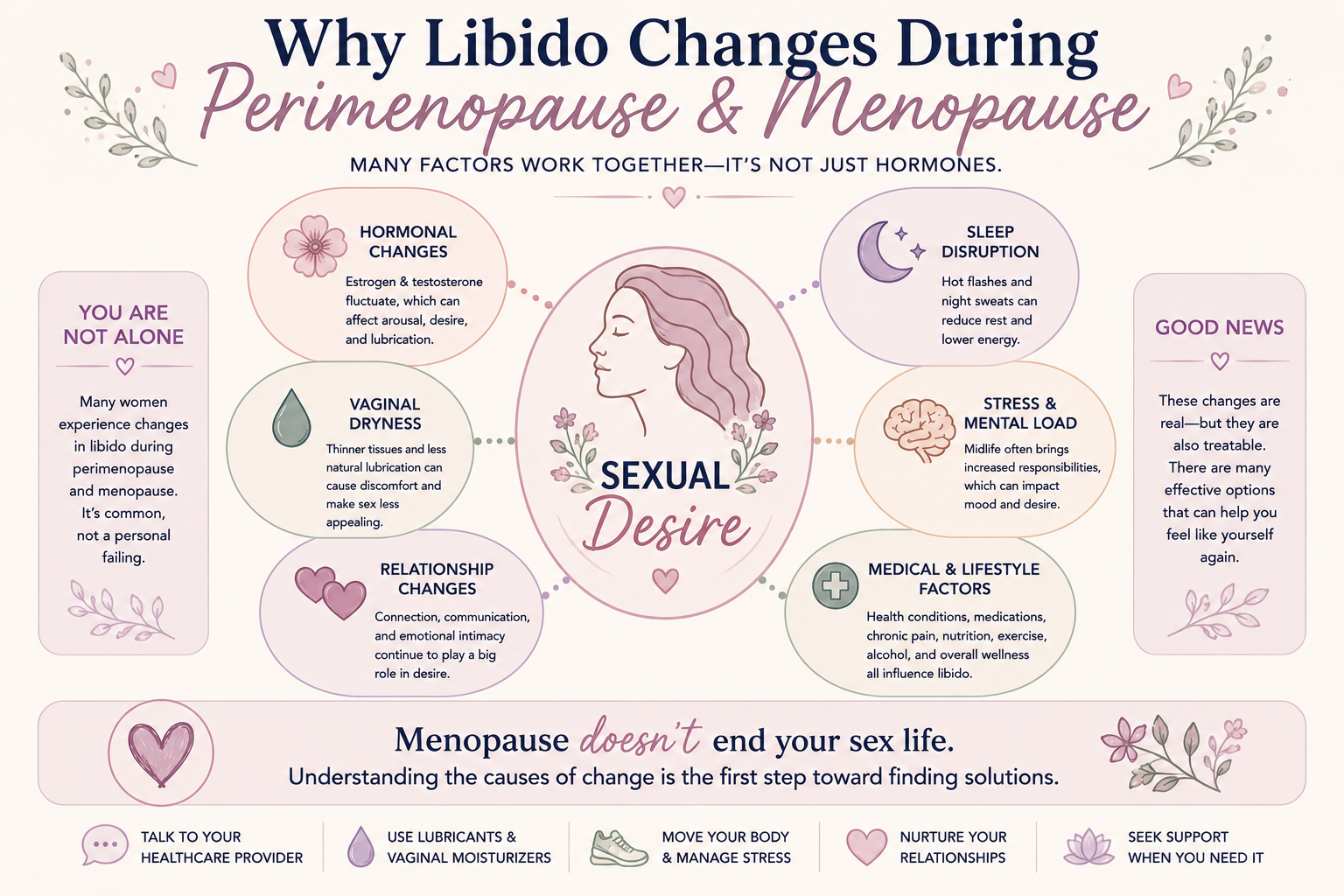
Low Libido and Aging
One of the biggest myths about sexuality is that growing older means your sex life has to end.
The truth is much more encouraging.
People of every age continue to experience sexual desire, intimacy, pleasure, and connection. While libido may change over time, aging itself does not automatically cause someone to lose interest in sex.
Instead, aging often brings physical, emotional, and lifestyle changes that can influence sexual desire.
Understanding those changes can help you find solutions that support a satisfying sex life at any age.
Does Libido Naturally Decrease With Age?
Sexual desire often changes throughout adulthood, but there is no age when people are "supposed" to stop wanting sex.
Some people notice very little change in libido as they age.
Others experience periods of lower desire followed by renewed interest later in life.
Everyone's experience is different.
Rather than focusing on age alone, it's more helpful to ask:
"What changes in my life might be influencing my libido?"
Why Libido May Change as We Get Older
Several factors become more common with age and can influence sexual desire.
These include:
Hormonal changes
Chronic health conditions
Medications
Sleep problems
Chronic pain
Stress
Retirement
Grief and loss
Caregiving responsibilities
Relationship changes
Body image
Often, it's the combination of these factors—not aging itself—that affects libido.
Physical Health Matters
As we get older, conditions such as diabetes, heart disease, arthritis, high blood pressure, sleep apnea, and chronic pain become more common.
These conditions can affect:
Energy
Comfort during sex
Blood flow
Hormone levels
Mood
Overall well-being
Managing your physical health is an important part of supporting your sexual health.
Hormonal Changes
Hormonal changes occur in both women and men as they age.
Women may experience:
Perimenopause
Menopause
Vaginal dryness
Changes in arousal
Men may experience gradual changes in testosterone, although these changes vary significantly from person to person.
Hormones are one piece of the puzzle—but rarely the entire story.
Medications
As people age, they're more likely to take medications for chronic health conditions.
Some medications may contribute to:
Lower sexual desire
Difficulty becoming aroused
Erectile difficulties
Delayed orgasm
If you've noticed changes after starting a medication, talk with your healthcare provider about your concerns.
Relationships Continue to Matter
Long-term relationships naturally evolve.
Children leave home.
Retirement changes daily routines. Partners are around each other more often.
Health concerns arise.
Partners become caregivers for one another.
Some couples find these transitions deepen emotional intimacy, while others struggle to reconnect after years of focusing on work and family.
Emotional connection, communication, and affection remain just as important later in life as they were in earlier years.
Life Transitions Can Affect Desire
Growing older often brings significant life changes.
You may be adjusting to:
Retirement
Becoming an empty nester
Caring for aging parents
Losing loved ones
Changes in identity
More free time
New routines
These transitions can influence both emotional well-being and sexual desire.
Aging Can Also Bring New Opportunities
Although people often focus on what changes with age, many individuals report enjoying sex more later in life.
Some people experience:
Greater confidence
Less pressure to perform
Better communication
More emotional intimacy
Greater comfort with their bodies
More freedom to explore what feels pleasurable
For many couples, sex becomes less about performance and more about connection.
There Is No "Normal" Sex Life for Your Age
There is no correct number of times people "should" have sex at any age.
A satisfying sex life looks different for every individual and every couple.
What's most important is whether your level of sexual activity and desire feels fulfilling for you and your partner.
When Should You Seek Help?
If changes in libido are causing distress or affecting your relationship, it's worth seeking support.
Treatment may include:
A medical evaluation
Medication review
Hormone assessment when appropriate
Pelvic floor physical therapy
Individual therapy
Many age-related concerns can be improved when the underlying causes are identified and addressed.
Healthy Sexuality Has No Expiration Date
Growing older doesn't mean giving up intimacy.
Sexuality is a lifelong part of being human.
Whether your definition of intimacy includes intercourse, touch, affection, kissing, cuddling, massage, or emotional closeness, meaningful connection remains possible throughout every stage of life.
Your sexual relationship may change as you age—but change does not have to mean loss.
Key Takeaway
Aging does not automatically cause low libido.
Instead, the physical, emotional, relational, and lifestyle changes that often accompany aging can influence sexual desire.
The encouraging news is that many of these factors are treatable.
With the right support, communication, and medical care when needed, people of every age can continue to experience fulfilling intimacy and satisfying sexual relationships.

Part 4: Diagnosis and Treatment
How Low Libido Is Diagnosed
If you're struggling with low libido, you may wonder whether there's a simple test that can tell you what's wrong.
The answer is both yes and no.
There isn't one blood test, scan, or questionnaire that can diagnose every case of low libido.
Instead, diagnosing low libido involves understanding the whole person—not just one symptom.
Your healthcare provider or therapist will look at your physical health, emotional well-being, relationships, medications, hormones, and life circumstances to identify the factors that may be influencing your sexual desire.
The First Step: A Conversation
The most important part of diagnosing low libido is having an open conversation about your symptoms.
Your provider may ask questions such as:
When did you notice your libido changing?
Was the change sudden or gradual?
Is it affecting your relationship or causing distress?
Do you still experience sexual thoughts or fantasies?
Do you experience arousal but little desire, or neither?
Has anything changed in your health, medications, or lifestyle?
Are you experiencing stress, anxiety, depression, or trauma?
Is sex painful or uncomfortable?
Have there been changes in your relationship?
These questions help identify patterns that may point toward the underlying cause.
A Medical Evaluation
Because low libido can sometimes be related to an underlying health condition, your healthcare provider may recommend a medical evaluation.
Depending on your symptoms, this may include:
A review of your medical history
A physical examination, when appropriate
A review of current medications
Discussion of chronic health conditions
Evaluation of sleep, pain, and overall health
The goal isn't simply to rule out disease.
It's to understand how your overall health may be influencing your sexual well-being.
Blood Tests and Hormone Testing
Many people assume hormone testing is the first step.
In reality, hormone testing is only recommended when it's appropriate based on your symptoms and medical history.
Depending on your situation, your healthcare provider may evaluate:
Thyroid function
Blood sugar levels
Iron levels
Vitamin deficiencies
Testosterone
Estrogen-related concerns
Prolactin
Other laboratory tests based on your symptoms
Normal laboratory results don't necessarily mean your low libido isn't real.
Likewise, abnormal results are only one piece of the larger picture.
Looking Beyond the Body
Sexual desire is influenced by far more than hormones.
Your provider may also explore:
Stress
Anxiety
Depression
Trauma history
Relationship satisfaction
Communication
Body image
Lifestyle habits
Sleep quality
Work-life balance
These conversations help identify emotional and relational factors that may be contributing to changes in libido.
Screening for Sexual Pain or Erectile Dysfunction
Sometimes low libido develops because sex has become physically difficult or uncomfortable.
Your provider may ask about:
For women:
Pain during sex
Vaginal dryness
Difficulty with arousal
Pelvic floor concerns
For men:
Changes in morning erections
Ejaculatory concerns
Changes in arousal
Understanding these symptoms helps determine whether additional evaluation or treatment is needed.
When Is Low Libido Considered a Problem?
Having a lower sex drive isn't automatically a medical diagnosis.
Low libido becomes a concern when it:
Causes significant personal distress.
Creates relationship difficulties.
Represents a meaningful change from your usual level of desire.
Persists despite changes in stress or life circumstances.
Is related to an underlying medical or psychological condition.
Some people naturally have lower levels of sexual desire than others—and that's completely healthy.
The goal isn't to match someone else's libido.
The goal is helping you have a sexual relationship that feels satisfying to you.
Who Should You See?
Depending on your symptoms, several healthcare professionals may be involved in your care.
A primary care provider can evaluate medical conditions, review medications, and order appropriate testing.
An OB-GYN can help address hormonal changes, vaginal dryness, pelvic pain, and menopause-related concerns.
A urologist may evaluate erectile dysfunction, prostate concerns, or testosterone-related questions.
A pelvic floor physical therapist can help treat pain during sex, pelvic floor dysfunction, and postpartum recovery.
A certified sex therapist can help address relationship concerns, stress, anxiety, trauma, desire differences, shame, communication, and the emotional aspects of sexual health.
Many people benefit from working with more than one professional, especially when multiple factors are contributing to low libido.
There Is No One-Size-Fits-All Diagnosis
One of the most important things to understand is that low libido rarely has one single cause.
You might discover that your decreased desire is related to:
Stress and burnout
Hormonal changes
A medication
Relationship challenges
Pain during sex
Trauma
Poor sleep
A medical condition
Or...
You may find that several of these factors are happening at the same time.
That's why a comprehensive evaluation is so valuable.
Key Takeaway
Diagnosing low libido isn't about finding one broken part.
It's about understanding the whole person.
When you identify the factors influencing your sexual desire, you can create a treatment plan that addresses the root causes—not just the symptoms.
The next section will explore the many evidence-based treatment options available for low libido and how to find the approach that's right for you.

When Should You See a Medical Provider?
Every person's libido changes from time to time.
Stressful weeks, busy seasons, illness, relationship changes, and major life transitions can all temporarily affect sexual desire.
However, if your low libido is persistent, causing distress, or affecting your quality of life, it's worth talking with a healthcare provider.
You don't have to wait until the problem becomes severe before asking for help.
Signs It's Time to Schedule an Appointment
Consider seeing a healthcare provider if:
Your libido has decreased suddenly without a clear explanation.
Your low sex drive has lasted for several months.
You're feeling distressed or frustrated by the change.
Your relationship is being affected.
You're experiencing erectile difficulties along with low desire.
You're concerned about hormonal changes.
Your libido changed after starting a new medication.
You're experiencing symptoms such as fatigue, unexplained weight changes, irregular menstrual cycles, hot flashes, or vaginal dryness.
You have a chronic medical condition that may be affecting your sexual health.
Remember, you don't need to "prove" your symptoms are severe enough to deserve help.
If your libido is concerning to you, that's reason enough to start the conversation.
Sudden Changes Shouldn't Be Ignored
A sudden decrease in sexual desire can sometimes be an early sign of an underlying medical condition.
Although many cases are related to stress or life circumstances, it's important to rule out treatable medical causes such as:
Thyroid disorders
Diabetes
Hormonal changes
Medication side effects
Sleep disorders
Depression or anxiety
Cardiovascular disease
Early evaluation can help identify these concerns before they become more serious.
Who Should You See?
The right provider depends on what's contributing to your symptoms.
Primary Care Provider
A primary care provider is often the best place to start.
They can:
Review your medical history
Order blood work when appropriate
Review medications
Screen for common medical conditions
Refer you to specialists if needed
OB-GYN
An OB-GYN can help if your symptoms involve:
Pregnancy or postpartum changes
Perimenopause or menopause
Vaginal dryness
Pain during sex
Hormonal concerns
Irregular menstrual cycles
Urologist
A urologist may be appropriate if you're experiencing:
Erectile dysfunction
Prostate concerns
Urinary symptoms
Questions about testosterone or other urologic conditions
Pelvic Floor Physical Therapist
If sex has become painful or uncomfortable, a pelvic floor physical therapist can evaluate and treat issues such as:
Pelvic floor dysfunction
Pain during sex
Muscle tension
Postpartum recovery
Scar tissue after childbirth or surgery
Certified Sex Therapist
A certified sex therapist can help when low libido is influenced by:
Stress or burnout
Anxiety or depression
Trauma
Desire differences between partners
Shame or negative beliefs about sex
Communication challenges
Sex therapy doesn't focus only on increasing desire—it helps identify and address the emotional, relational, and psychological factors affecting your sexual well-being.
You May Benefit From More Than One Professional
Low libido rarely has a single cause.
For example, someone experiencing painful sex during menopause might benefit from:
An OB-GYN for medical treatment.
A pelvic floor physical therapist to address pain.
A sex therapist to rebuild confidence, communication, and intimacy.
Working with a team of professionals often provides the most comprehensive care.
Preparing for Your Appointment
Many people feel nervous bringing up concerns about their sex life.
It may help to write down:
When your libido changed.
Any medications you're taking.
Other symptoms you've noticed.
Questions you want to ask.
How your relationship has been affected.
Remember, healthcare providers discuss sexual concerns every day.
You don't need to feel embarrassed about asking for help.
You Deserve Answers
Many people assume low libido is simply something they have to live with.
Fortunately, that's rarely the case.
Whether your decreased desire is related to hormones, stress, a medical condition, medications, relationship concerns, or several factors working together, help is available.
The first step is starting the conversation.
Key Takeaway
If your low libido is persistent, causing distress, or affecting your quality of life, don't ignore it.
A healthcare provider can help identify the underlying causes and connect you with the right treatment.
You don't have to figure it out on your own—and you don't have to accept low libido as your new normal.

What Medical Tests Might Be Recommended?
One of the first questions many people ask is:
"Should I get my hormones checked?"
The answer depends on your symptoms.
There isn't one blood test that can diagnose low libido, and not everyone needs extensive laboratory testing.
Instead, your healthcare provider will recommend tests based on your medical history, symptoms, age, current medications, and physical examination.
The goal is to identify any medical conditions that may be contributing to changes in your sexual desire.
Blood Tests That May Be Recommended
Depending on your symptoms, your healthcare provider may recommend blood work to evaluate your overall health.
Common tests may include:
Complete Blood Count (CBC)
Comprehensive Metabolic Panel (CMP)
Hemoglobin A1c or fasting glucose to screen for diabetes
Lipid panel (cholesterol)
Iron studies, when indicated
Vitamin B12
Vitamin D, when appropriate
These tests can help identify health conditions that may contribute to fatigue, low energy, or decreased libido.
Thyroid Testing
Because thyroid disorders are a common and treatable cause of changes in energy, mood, and sexual desire, many providers recommend evaluating thyroid function when symptoms suggest it may be contributing.
Testing may include:
Thyroid-Stimulating Hormone (TSH)
Free T4
Additional thyroid testing when clinically indicated
Both an underactive thyroid (hypothyroidism) and an overactive thyroid (hyperthyroidism) can influence libido.
Hormone Testing
Hormone testing isn't necessary for everyone with low libido.
However, it may be appropriate if you're experiencing symptoms such as:
A sudden decrease in sexual desire
Menstrual changes
Hot flashes
Night sweats
Erectile difficulties
Loss of morning erections
Vaginal dryness
Symptoms of menopause or perimenopause
Persistent fatigue
Depending on your symptoms, your healthcare provider may evaluate:
For women:
Estradiol (estrogen)
Follicle-Stimulating Hormone (FSH), when appropriate
Other hormone testing based on your medical history
For men:
Total testosterone (typically measured in the morning)
Free testosterone, when appropriate
Additional hormone testing if results are abnormal or symptoms suggest another condition
Hormone testing should always be interpreted alongside your symptoms rather than relying on laboratory numbers alone.
Prolactin Testing
If your healthcare provider suspects a hormonal imbalance affecting sexual desire, they may recommend checking prolactin levels.
Elevated prolactin can contribute to:
Reduced libido
Menstrual changes
Erectile difficulties
Fertility concerns
Although elevated prolactin is uncommon, it's an important condition to identify because it can often be treated.
Additional Testing
Depending on your symptoms, your provider may recommend additional testing to evaluate for other medical conditions.
This might include:
Sleep studies if sleep apnea is suspected
Cardiovascular evaluation for heart or circulation concerns
Pelvic examination if you're experiencing pain during sex
Urologic evaluation for erectile dysfunction or prostate concerns
Imaging or specialist referrals if another medical condition is suspected
Not everyone will need these evaluations. Your provider will recommend testing based on your individual health history.
What If My Blood Work Is Normal?
Many people worry that normal blood work means their symptoms aren't real.
Fortunately, that's not how sexual health works.
It's entirely possible to have normal laboratory results and still experience low libido.
Stress, anxiety, depression, trauma, relationship concerns, burnout, medications, poor sleep, and life transitions often affect sexual desire without changing blood test results.
Normal labs simply help rule out certain medical causes—they don't rule out the very real emotional, relational, or psychological factors that influence libido.
The Goal Isn't More Testing—It's the Right Testing
More testing doesn't always mean better care.
The best evaluation focuses on your unique symptoms rather than ordering every possible laboratory test.
By combining a thorough medical history, physical health evaluation, appropriate laboratory testing, and an understanding of your emotional and relationship health, your healthcare team can develop a treatment plan that addresses the root causes of your low libido.
Key Takeaway
Medical testing can provide valuable information when evaluating low libido, but there isn't one "libido test."
The most effective evaluation combines appropriate medical testing with a comprehensive understanding of your physical health, mental health, relationships, lifestyle, and personal experiences.
The goal isn't simply to find an abnormal lab result—it's to understand the whole picture so you can receive the most effective treatment.
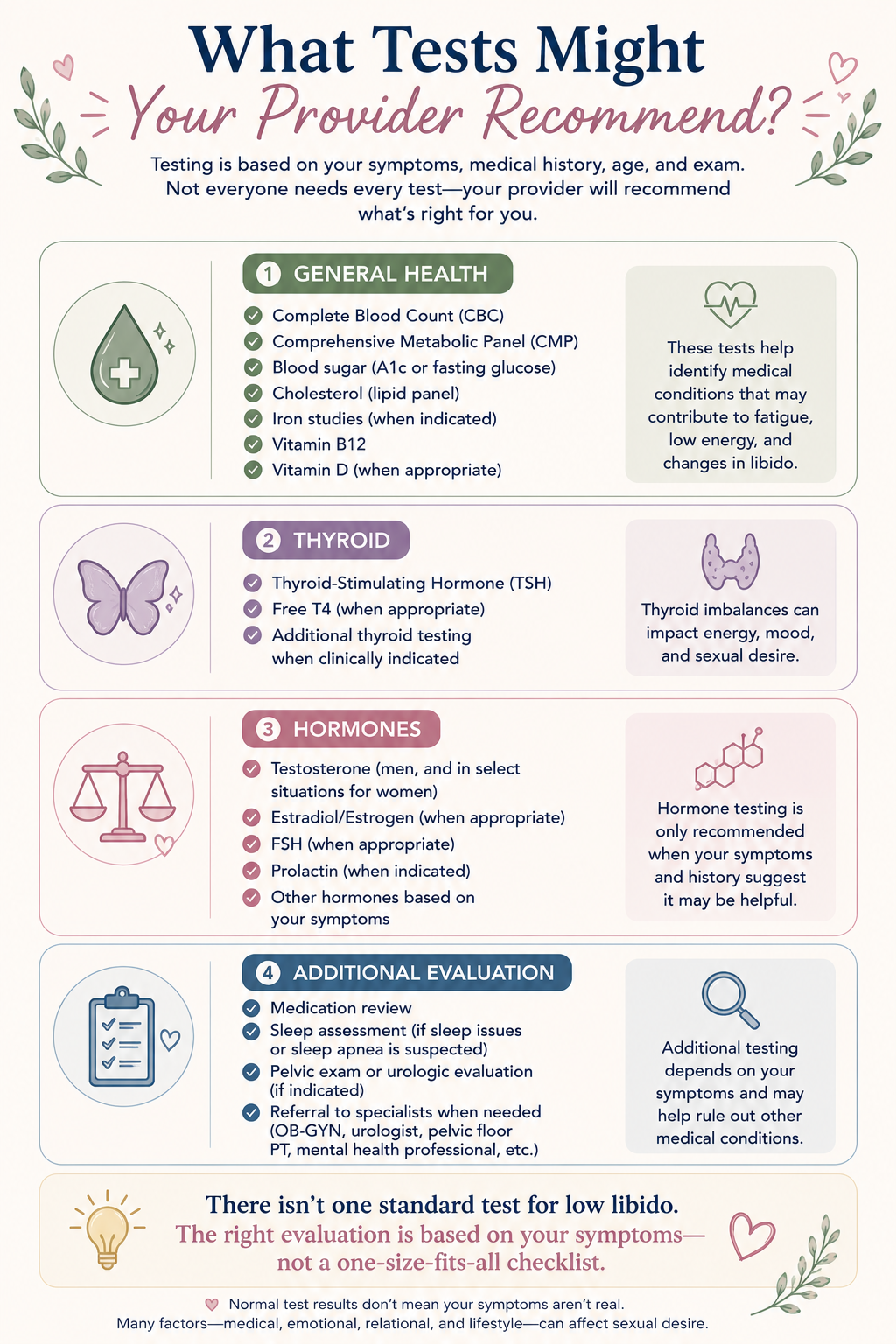
When Should You See a Sex Therapist?
Many people wonder whether their low libido is "serious enough" to see a sex therapist.
The truth is, you don't have to wait until your relationship is falling apart or your sex life feels nonexistent before asking for help.
If changes in your sexual desire are causing distress, affecting your relationship, or leaving you feeling confused or frustrated, sex therapy can help.
Sex therapy is designed to help people understand the many physical, emotional, psychological, and relational factors that influence sexuality—and develop practical strategies for improving intimacy and sexual well-being.
What Is a Sex Therapist?
A sex therapist is a licensed mental health professional with specialized training in human sexuality and sexual concerns.
Sex therapists work with individuals and couples experiencing challenges such as:
Low libido
Desire differences between partners
Difficulty with orgasm
Communication about sex
Sexual shame
The goal isn't simply to help people have more sex.
The goal is to help people develop a healthier, more satisfying relationship with their sexuality.
Signs You May Benefit From Sex Therapy
You don't need a diagnosis to benefit from sex therapy.
Consider seeking support if:
Your low libido is causing distress.
You and your partner have different levels of sexual desire.
You're avoiding intimacy because of anxiety, pain, or fear.
Medical testing hasn't fully explained your symptoms.
Stress or burnout is affecting your sex life.
Trauma is making intimacy difficult.
You're struggling with body image or sexual confidence.
You're having difficulty communicating with your partner about sex.
You're feeling disconnected from your partner.
You're simply looking for guidance to improve your sexual relationship.
Seeking help early often makes these concerns easier to address.
What Happens in Sex Therapy?
Many people imagine that sex therapy involves discussing explicit sexual details or engaging in sexual activities during sessions.
That isn't how sex therapy works.
Sex therapy is talk therapy.
Your therapist will work with you to understand your concerns, identify the factors affecting your sexual well-being, and develop a treatment plan based on your goals.
Sessions may include discussions about:
Your relationship history
Medical history
Stress and mental health
Communication patterns
Sexual beliefs and expectations
Past experiences
Emotional connection
Desire differences
Practical strategies for improving intimacy
There is never any sexual touching, nudity, or sexual activity during a sex therapy session.
Can Sex Therapy Help If My Low Libido Is Medical?
Yes.
Even when a medical condition contributes to low libido, sex therapy can still be helpful.
Many people benefit from learning how to:
Adapt to physical changes
Improve communication with their partner
Reduce anxiety surrounding intimacy
Rebuild confidence
Strengthen emotional connection
Create new ways of experiencing pleasure
Sex therapy often works best alongside appropriate medical care.
Sex Therapy for Individuals
You don't need to be in a relationship to benefit from sex therapy.
Individual therapy may focus on:
Understanding your libido
Healing from trauma
Addressing shame or guilt
Improving body image
Exploring your sexuality
Managing anxiety or stress
Increasing confidence in intimate relationships
Your relationship with yourself is an important part of your sexual health.
Couples Sex Therapy
When low libido is affecting a relationship, couples sex therapy can provide a supportive space to explore the issue together.
Rather than blaming one partner, therapy focuses on understanding the factors contributing to the change and helping couples build a sexual relationship that works for both people.
Common goals include:
Improving communication
Reducing pressure around sex
Navigating desire differences
Rebuilding emotional connection
Increasing intimacy
Developing realistic expectations
Healthy relationships aren't built on having identical libidos—they're built on understanding, flexibility, and teamwork.
Sex Therapy Is About More Than Sex
One of the biggest surprises for many clients is that sex therapy often involves talking about much more than sex.
We may explore:
Stress
Sleep
Mental health
Trauma
Relationships
Parenting
Work-life balance
Communication
Attachment
Emotional safety
Because sexuality is connected to every part of our lives, improving your sex life often starts outside the bedroom.
You Don't Have to Figure It Out Alone
Many people silently struggle with low libido for years before reaching out for help.
They worry they'll be judged, misunderstood, or told that their concerns aren't important.
Your sexual health deserves the same care and attention as every other aspect of your well-being.
Seeking support isn't a sign that something is wrong with you.
It's a sign that you're investing in your health, your relationships, and your quality of life.
Key Takeaway
You don't have to wait until low libido becomes a crisis before seeking help.
Whether your concerns are related to stress, hormones, trauma, relationships, medical conditions, or several factors working together, sex therapy can help you better understand your sexuality and develop a plan that supports lasting change.
You deserve a sex life that feels connected, fulfilling, and authentic—and you don't have to find your way there alone.

Evidence-Based Treatment Options for Low Libido
One of the most encouraging things to know about low libido is this:
It is often treatable.
Because sexual desire is influenced by many factors—including your physical health, mental health, relationships, hormones, medications, and lifestyle—the most effective treatment depends on what's contributing to your symptoms.
There isn't a single treatment that works for everyone.
Instead, the goal is to identify the underlying causes and create a personalized plan that supports your overall sexual well-being.
Medical Treatment
If a medical condition is contributing to your low libido, treating the underlying issue may improve sexual desire.
Depending on your situation, treatment may include:
Managing thyroid disorders
Treating diabetes or other chronic health conditions
Addressing chronic pain
Improving sleep disorders
Treating depression or anxiety
Adjusting medications that affect sexual desire
Managing menopause or hormonal symptoms
Sometimes improving overall health naturally improves sexual health.
Hormone Therapy
For some people, hormone therapy may be an appropriate treatment option.
This depends on factors such as:
Your age
Medical history
Symptoms
Laboratory findings
Overall health
Hormone therapy is not appropriate for everyone, and it should always be discussed with a qualified healthcare provider.
The goal is to treat documented hormonal concerns—not simply to increase libido.
Medication Adjustments
If your libido changed after starting a medication, your prescribing provider may recommend:
Adjusting the dose
Changing when you take the medication
Switching to another medication
Considering treatments that reduce sexual side effects
Never stop taking a prescribed medication without first speaking with your healthcare provider.
Pelvic Floor Physical Therapy
For people experiencing pain during sex, pelvic floor dysfunction, postpartum recovery, or muscle tension, pelvic floor physical therapy can be an important part of treatment.
Treatment may help improve:
Muscle tension
Pelvic floor coordination
Comfort during intimacy
Confidence with sexual activity
When sex becomes more comfortable, desire often has more opportunity to return.
Sex Therapy
Sex therapy addresses the emotional, psychological, and relationship factors that influence sexual desire.
A sex therapist can help you:
Understand what's contributing to your low libido
Reduce anxiety surrounding sex
Improve communication with your partner
Address sexual shame
Heal from trauma
Navigate desire differences
Rebuild emotional and physical intimacy
For many people, sex therapy is an important part of creating lasting change.
Couples Therapy
When low libido is affecting a relationship, couples intimacy therapy can help partners work together rather than against each other.
Therapy may focus on:
Improving communication
Rebuilding emotional connection
Reducing conflict
Navigating differences in desire
Creating realistic expectations
Developing new ways of experiencing intimacy
Healthy relationships are strengthened through understanding—not blame.
Lifestyle Changes
Small lifestyle changes can also support sexual well-being.
These may include:
Improving sleep
Increasing physical activity
Managing stress
Eating a balanced diet
Reducing alcohol use, when appropriate
Prioritizing time for rest and connection
Lifestyle changes rarely solve every case of low libido on their own, but they often strengthen the effectiveness of other treatments.
Trauma-Informed Therapy
If trauma is affecting your relationship with intimacy, trauma-informed therapy can help you rebuild a sense of safety, trust, and connection.
Evidence-based approaches such as EMDR and other trauma-focused therapies may help reduce the emotional impact of traumatic experiences and support healing.
Healing isn't about forcing desire.
It's about creating the conditions where desire has the opportunity to return.
Combining Treatments Often Works Best
For many people, the most effective treatment plan includes more than one approach.
For example, someone experiencing menopause-related low libido might benefit from:
An OB-GYN
Local hormone treatment, when appropriate
Pelvic floor physical therapy
Sex therapy
Lifestyle changes
Another person experiencing stress-related low libido might benefit from:
Stress management
Individual therapy
Couples therapy
Better sleep
Improved work-life balance
There is no one-size-fits-all solution because there is no one-size-fits-all cause.
Healing Takes Time
Many people hope for a quick fix.
While some treatments produce noticeable improvements fairly quickly, lasting change often happens gradually.
Your libido reflects the health of your body, your nervous system, your relationships, and your emotional well-being.
Improving those systems takes time.
Be patient with yourself.
Progress is often measured in small, meaningful steps.
There Is Hope
Low libido is one of the most common sexual concerns people experience.
It is also one of the most treatable.
Whether your low libido is related to hormones, stress, trauma, medications, relationship concerns, chronic illness, or several factors working together, effective, evidence-based treatment is available.
You deserve care that looks beyond the symptoms and helps you understand the whole picture.
Key Takeaway
The best treatment for low libido isn't a single medication, supplement, or technique.
It's a personalized plan based on your unique needs.
When treatment addresses the underlying causes—not just the symptoms—many people experience meaningful improvements in desire, intimacy, and overall quality of life.
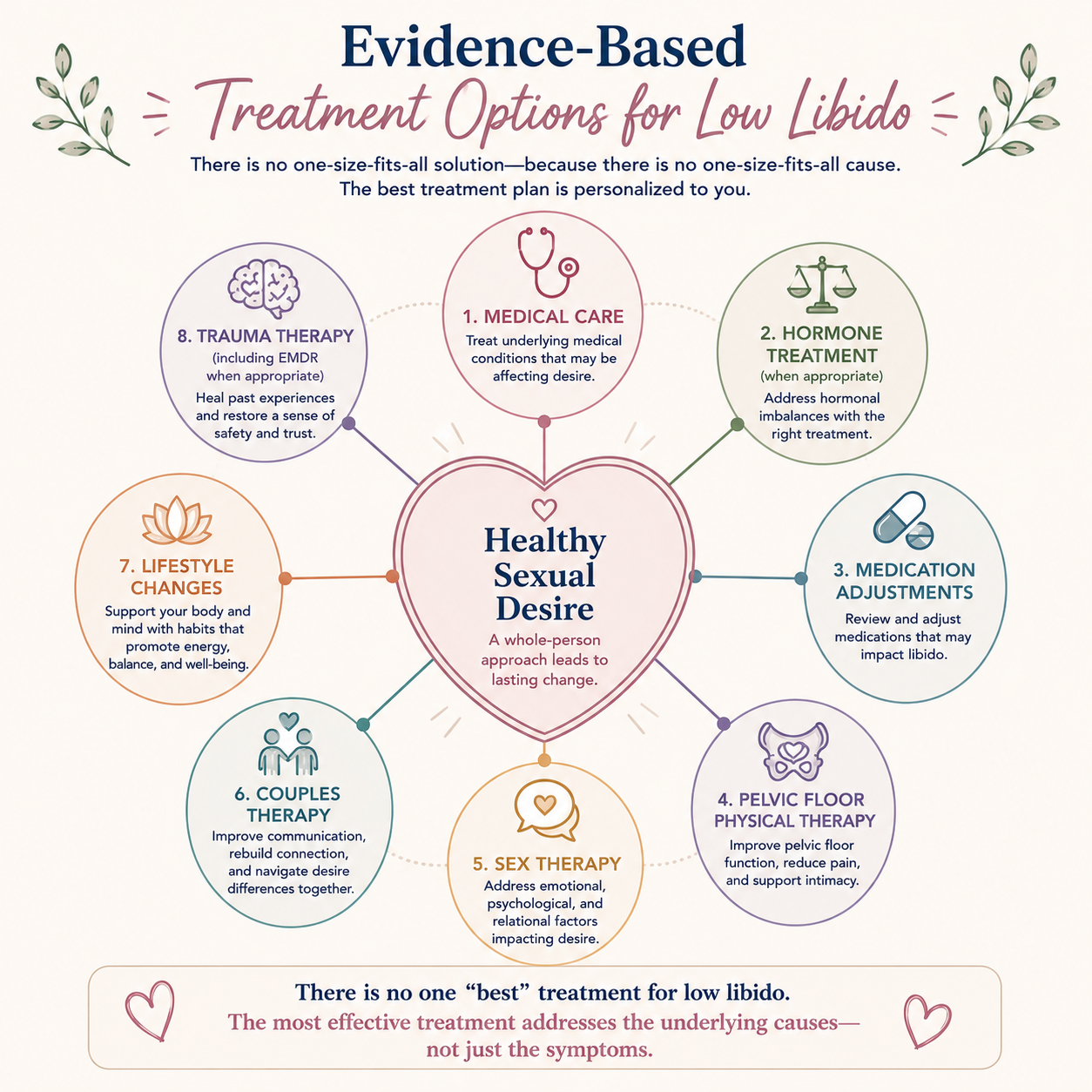
Part 5: Improving Your Sex Life
Practical Ways to Increase Sexual Desire
If you've made it this far, you've probably realized something important:
There isn't one simple reason people experience low libido.
The good news is that there also isn't just one way to improve it.
Building a healthier sex life isn't about finding a magic supplement or forcing yourself to want sex more often. It's about creating the physical, emotional, and relational conditions where desire has the opportunity to grow.
The following strategies are supported by research and commonly recommended by healthcare professionals and certified sex therapists.
1. Understand Your "Why"
Before trying to increase your libido, take time to understand what's contributing to the change.
Ask yourself:
Am I overwhelmed or burned out?
Am I getting enough sleep?
Has my relationship changed?
Have I started a new medication?
Am I experiencing pain during sex?
Have I experienced a recent life transition?
Could my hormones or physical health be playing a role?
Understanding the cause is the foundation of choosing the right solution.
2. Reduce Pressure Around Sex
One of the quickest ways to decrease desire is to make sex feel like another task on your to-do list.
Instead of asking yourself:
"I have to want sex tonight."
Try asking:
"How can we create more opportunities for connection?"
When pressure decreases, desire often has more room to emerge.
3. Focus on Emotional Intimacy
For many people, emotional connection is closely tied to sexual desire.
Small moments of connection matter.
Try:
Spending uninterrupted time together
Expressing appreciation
Holding hands
Hugging for a little longer
Kissing without expecting sex
Asking meaningful questions about each other's day
Emotional intimacy often creates the foundation for physical intimacy.
4. Learn About Responsive Desire
Many people believe they should feel spontaneous sexual desire before becoming intimate.
In reality, many people—especially those in long-term relationships—experience responsive desire, meaning desire develops after intimacy has already begun.
You may not feel interested in sex while folding laundry or answering emails.
But after cuddling, laughing together, kissing, or slowing down, desire may gradually appear.
Understanding responsive desire helps many people stop believing something is "wrong" with them.
5. Prioritize Rest and Recovery
A body that's exhausted is less likely to prioritize pleasure.
Improving sleep, reducing chronic stress, and creating time for recovery can have a meaningful impact on sexual desire.
Ask yourself:
"What does my body need today?"
Sometimes the answer isn't sex.
Sometimes it's sleep.
6. Care for Your Physical Health
Supporting your overall health also supports your sexual health.
Simple habits can make a difference over time:
Move your body regularly.
Eat nourishing meals.
Stay hydrated.
Limit alcohol when appropriate.
Follow your treatment plan for chronic health conditions.
Attend routine medical appointments.
The goal isn't perfection.
It's creating a healthier foundation for your body.
7. Make Space for Pleasure
Pleasure isn't limited to intercourse.
Reconnect with activities that help you feel alive and present.
This might include:
Dancing
Taking a bath
Listening to music
Spending time in nature
Receiving a massage
Practicing mindfulness
Reading erotica, if that feels right for you
Exploring self-pleasure without pressure or performance goals
Learning what brings you pleasure outside the bedroom often supports desire inside the bedroom.
8. Talk Openly With Your Partner
Many couples avoid talking about sex because they're afraid of hurting each other's feelings.
Ironically, avoiding the conversation often creates more distance.
Try approaching the conversation with curiosity instead of blame.
Instead of saying:
"You never want sex."
Try saying:
"I miss feeling close to you. Can we talk about what's been going on for both of us?"
Compassion opens more doors than criticism.
9. Let Go of Sexual Myths
Many people carry unrealistic expectations about sex.
For example:
Healthy couples don't need to have sex a certain number of times each week.
Desire naturally changes throughout life.
Great sex isn't measured by frequency alone.
Intimacy can look different from one couple to another.
Rather than comparing your relationship to social media or cultural expectations, focus on creating a sexual relationship that feels satisfying for both of you.
10. Ask for Help When You Need It
If you've been struggling for several months or your low libido is causing distress, don't wait until things become overwhelming.
Medical providers, pelvic floor physical therapists, and certified sex therapists can help identify the underlying causes and create a personalized treatment plan.
Seeking support isn't giving up.
It's taking an active role in your sexual health.
Progress Is More Important Than Perfection
Improving your libido isn't about fixing yourself.
It's about understanding yourself.
Some changes happen quickly.
Others take time.
Be patient with your body, your mind, and your relationship.
Small, consistent steps often lead to meaningful improvements over time.
Key Takeaway
There isn't one secret to increasing sexual desire.
Healthy libido grows when your body feels well cared for, your nervous system feels safe, your relationships feel connected, and your unique needs are understood.
The goal isn't chasing someone else's definition of a "normal" sex life.
The goal is creating a sex life that feels fulfilling, connected, and authentic to you.

How to Rebuild Intimacy in Your Relationship
When couples experience low libido, they often focus on one question:
"How can we have more sex?"
While that's understandable, a more helpful question is often:
"How can we feel more connected?"
For many couples, intimacy begins long before the bedroom.
Feeling emotionally safe, understood, appreciated, and connected creates the foundation where sexual desire has the opportunity to grow.
Rather than trying to force desire, focus on rebuilding the relationship that supports it.
Start With Connection, Not Performance
Many couples unknowingly fall into a cycle of pressure.
One partner initiates.
The other feels guilty for saying no.
Both partners begin feeling rejected, frustrated, or disconnected.
Over time, sex can start to feel like a test rather than an opportunity for closeness.
Instead of focusing on performance, shift your attention toward connection.
Ask yourself:
"What helps us feel emotionally close?"
Spend Time Together Without the Goal of Sex
Not every affectionate moment needs to lead to intercourse.
In fact, removing that expectation can reduce pressure and help both partners relax.
Try:
Holding hands during a walk.
Watching a movie while cuddling.
Hugging for 20 seconds.
Kissing good morning or goodnight.
Cooking dinner together.
Laughing together.
Going on a date without expecting sex afterward.
Affection without pressure often rebuilds trust around physical closeness.
Improve Communication
Many couples avoid talking about sex because they're afraid of hurting each other's feelings.
Unfortunately, silence often creates more distance.
Instead of blaming or criticizing, try approaching conversations with curiosity.
For example:
Instead of saying:
"You never want sex anymore."
Try:
"I've been missing feeling close to you. Can we talk about what intimacy has been like for each of us lately?"
The goal isn't to win an argument.
The goal is to understand each other's experiences.
Learn Each Other's Love Languages
People don't always experience love in the same way.
Some people feel most connected through:
Words of affirmation
Quality time
Physical touch
Acts of service
Thoughtful gifts
Learning how your partner experiences love can strengthen emotional intimacy outside the bedroom.
Make Time for Play
Desire often grows in relationships that still have room for fun.
Playfulness activates curiosity, laughter, and novelty—qualities that can support intimacy.
Consider:
Trying a new restaurant.
Taking a dance class.
Playing a board game.
Going on a hike.
Traveling somewhere new.
Trying a new hobby together.
The goal isn't simply to "spice things up."
It's to create new experiences that help you reconnect as partners.
Redefine Intimacy
Many couples unintentionally define intimacy as intercourse.
But intimacy is much broader than that.
Intimacy can include:
Holding each other.
Talking late into the evening.
Giving a massage.
Sharing fantasies.
Making eye contact.
Laughing together.
Taking a shower together.
Kissing.
Cuddling.
Simply feeling emotionally understood.
When couples expand their definition of intimacy, they often discover many more opportunities to connect.
Create Space for Responsive Desire
Many people in long-term relationships experience responsive rather than spontaneous desire.
That means desire may not appear until after affection has already begun.
Rather than waiting to "feel in the mood," consider creating intentional opportunities for closeness.
Sometimes desire follows connection—not the other way around.
Reduce Stress Together
Stress affects relationships just as much as it affects libido.
Instead of tackling stress individually, ask:
"What can we do as a team to make life feel a little easier?"
Maybe it's sharing household responsibilities.
Maybe it's hiring help if possible.
Maybe it's protecting one evening each week for each other.
Reducing stress creates more space for intimacy.
Practice Appreciation
Long-term couples often notice problems more easily than positives.
A simple daily habit can help shift that pattern.
Each day, tell your partner one thing you appreciate about them.
Small moments of gratitude help strengthen emotional connection over time.
Be Patient With the Process
Rebuilding intimacy doesn't happen overnight.
If you've been feeling disconnected for months—or years—it takes time to create new patterns.
Progress might look like:
Talking more openly.
Holding hands again.
Laughing together more often.
Feeling emotionally safer.
Wanting to spend more time together.
These are meaningful signs that your relationship is moving in a healthy direction.
When to Seek Couples Sex Therapy
Sometimes couples need support breaking out of long-standing patterns.
A certified sex therapist can help couples:
Navigate differences in desire.
Improve communication.
Heal after betrayal or trauma.
Reduce pressure surrounding sex.
Rebuild trust.
Strengthen emotional intimacy.
Develop a sexual relationship that works for both partners.
Seeking help isn't a sign that your relationship is failing.
It's a sign that your relationship matters.
Key Takeaway
A satisfying sex life doesn't begin with perfect technique or having sex a certain number of times each week.
It begins with emotional safety, trust, communication, friendship, and connection.
When couples invest in their relationship outside the bedroom, desire often has the opportunity to grow inside the bedroom.
Remember:
Connection isn't the reward for great sex.
For many couples, connection is what makes great sex possible.

What Partners Should Know About Low Libido
If your partner is experiencing low libido, you may be feeling confused, hurt, lonely, or even rejected.
Those feelings are real and understandable.
At the same time, it's important to remember that a decrease in sexual desire is rarely a reflection of how much someone loves or values their partner.
More often, low libido is the result of physical, emotional, psychological, relational, or lifestyle factors working together.
When couples begin viewing low libido as a shared challenge instead of one person's problem, they are much more likely to find solutions together.
Low Libido Is Usually Not About You
One of the most common assumptions partners make is:
"They don't want me anymore."
While attraction can certainly play a role in some relationships, most cases of low libido are influenced by factors such as:
Stress
Burnout
Hormonal changes
Medical conditions
Medications
Anxiety
Depression
Trauma
Parenting demands
Relationship dynamics
Instead of asking:
"Why don't they want me?"
Try asking:
"What might they be carrying right now?"
That shift in perspective can change the entire conversation.
Avoid Taking the Role of the Problem Solver
It's natural to want to "fix" the situation.
However, repeatedly suggesting supplements, medications, or articles can sometimes make your partner feel like they're being treated as a problem to solve.
Instead, try leading with curiosity.
Ask:
"How have you been feeling lately?"
"Is there anything that's making intimacy harder right now?"
"How can I support you?"
Feeling understood often creates more safety than feeling pressured.
Reduce Pressure Around Sex
Pressure is one of the biggest obstacles to desire.
If every hug, kiss, or cuddle feels like it has to lead to sex, your partner may begin avoiding affection altogether.
Instead, create opportunities for physical closeness without expectations.
This might include:
Holding hands
Cuddling on the couch
Giving each other a hug before work
Kissing goodnight
Sitting close while watching a movie
Affection without pressure helps rebuild emotional and physical safety
Listen Before You Try to Fix
Sometimes your partner doesn't need advice.
They need someone who is willing to listen.
Practice listening with the goal of understanding rather than responding.
Ask questions.
Validate their experience.
Resist the urge to immediately offer solutions.
Feeling heard is often one of the most powerful forms of support.
Work as a Team
Low libido affects both partners, but that doesn't mean one person is to blame.
Approach the situation as a shared challenge.
Use language like:
"How can we work on this together?"
"What would help us feel more connected?"
"What support do we need?"
Team language reduces defensiveness and strengthens connection.
Keep Building Emotional Intimacy
Don't let your relationship become defined by conversations about sex.
Continue nurturing your friendship.
Laugh together.
Go on dates.
Share new experiences.
Express appreciation.
Small moments of connection often become the building blocks of intimacy.
Respect Boundaries While Staying Connected
Supporting your partner doesn't mean ignoring your own needs.
Healthy relationships make room for both partners' experiences.
It's okay to express feelings of disappointment or loneliness while also respecting your partner's boundaries.
The goal isn't choosing one person's needs over the other's.
It's creating a relationship where both people feel heard, valued, and respected.
Encourage Help Without Shame
If low libido has become a source of ongoing distress, encourage your partner to seek support—but avoid ultimatums or criticism.
You might say:
"I know this has been hard for both of us. If you're open to it, I'd love for us to talk with someone together."
Approaching therapy as a shared investment in the relationship often feels much more supportive than suggesting one partner needs to be "fixed."
Remember That Intimacy Is Bigger Than Sex
Physical intimacy is important, but it's only one part of a healthy relationship.
Continue nurturing:
Trust
Affection
Emotional safety
Friendship
Shared experiences
Communication
Playfulness
These aspects of your relationship often create the conditions where sexual desire can grow.
You're on the Same Team
It's easy for couples to slip into opposite corners:
One partner feels rejected.
The other feels pressured.
Neither partner feels understood.
Remember that low libido isn't something the two of you are fighting against each other.
It's something the two of you can face together.
When couples replace blame with curiosity and pressure with compassion, they create space for both healing and intimacy.
Key Takeaway
If your partner has low libido, the most powerful thing you can offer isn't pressure or perfect advice.
It's understanding.
Approach the conversation with curiosity, compassion, and teamwork.
When both partners feel emotionally safe, respected, and supported, it's often easier to begin rebuilding intimacy together.

Common Mistakes Couples Make When Desire Is Different
Every couple has differences.
Different personalities.
Different communication styles.
Different love languages.
And often...
Different levels of sexual desire.
Having different libidos doesn't mean your relationship is unhealthy.
In fact, desire discrepancy is one of the most common concerns couples bring to sex therapy.
The problem usually isn't that partners have different sex drives.
The problem is how they respond to those differences.
Here are some of the most common mistakes couples make—and what to do instead.
Mistake #1: Assuming Someone Is to Blame
When desire changes, couples often start looking for the "problem."
One partner may think:
"Something is wrong with me."
The other may think:
"If they loved me, they'd want sex more."
Neither assumption is usually true.
Low libido is rarely one person's fault.
Instead, it's often influenced by stress, hormones, health, relationship dynamics, life transitions, medications, and emotional well-being.
Instead of asking:
"Who's causing this?"
Try asking:
"What might be contributing to this?"
That shift changes the conversation from blame to teamwork.
Mistake #2: Taking Low Libido Personally
It's easy to interpret a decline in sexual desire as rejection.
Many partners wonder:
"Are they still attracted to me?"
"Did I do something wrong?"
"Am I no longer enough?"
While those feelings are understandable, low libido is often about what's happening inside your partner—not about how they feel about you.
Curiosity usually leads to more productive conversations than assumptions.
Mistake #3: Creating Pressure Around Sex
Pressure is one of the fastest ways to reduce desire.
When every hug, kiss, or affectionate touch is expected to lead to sex, the lower-desire partner may begin avoiding physical closeness altogether.
Over time, both partners lose.
Instead, make room for affection without expectations.
A hug can simply be a hug.
A kiss can simply be a kiss.
Creating safety around physical touch often helps intimacy return.
Mistake #4: Stopping All Physical Affection
After repeated rejection, some partners stop initiating any affection at all.
Others withdraw emotionally to protect themselves from disappointment.
Unfortunately, this often increases distance rather than reducing it.
Continue nurturing your friendship through:
Holding hands
Sitting close together
Hugging
Laughing
Going on dates
Sharing meaningful conversations
Intimacy is much bigger than intercourse.
Mistake #5: Avoiding the Conversation
Many couples avoid talking about sex because they fear conflict.
Unfortunately, silence allows misunderstandings to grow.
Instead of waiting until frustration boils over, create regular opportunities to talk about intimacy with curiosity and compassion.
Healthy conversations aren't about convincing your partner.
They're about understanding each other's experiences.
Mistake #6: Waiting Until Everything Feels Perfect
Many couples believe they'll reconnect sexually once life slows down.
After work becomes less stressful.
After the kids are older.
After the next vacation.
After the house is cleaner.
Life rarely becomes perfectly calm.
Instead of waiting for the perfect moment, look for small opportunities to nurture connection now.
Mistake #7: Believing Great Sex Should Be Effortless
Movies and social media often portray desire as something that happens naturally without communication or planning.
Real relationships are different.
Long-term intimacy often requires:
Intention
Communication
Flexibility
Curiosity
Time
Needing to work on your relationship isn't a sign that it's failing.
It's a sign that it matters.
Mistake #8: Focusing Only on Frequency
Many couples judge the health of their relationship by how often they have sex.
But frequency tells only a small part of the story.
A couple who has sex once a month and feels deeply connected may be far more satisfied than a couple who has sex several times a week but feels disconnected.
Quality matters just as much as quantity.
Instead of asking:
"How often are we having sex?"
Try asking:
"Do we both feel connected, desired, and understood?"
Mistake #9: Trying to Solve It Alone
Many couples struggle with desire differences for years before asking for help.
By the time they seek support, both partners often feel discouraged and disconnected.
You don't have to wait until your relationship reaches a breaking point.
Working with a certified sex therapist can help couples:
Improve communication
Reduce pressure around sex
Navigate desire differences
Strengthen emotional intimacy
Address underlying causes of low libido
Build a sexual relationship that works for both partners
Seeking support early often makes the process easier.
Different Doesn't Mean Broken
No two people have identical sexual desire throughout a relationship.
Desire naturally changes over time.
The healthiest couples aren't the ones who never experience differences.
They're the ones who learn how to talk about those differences with empathy, flexibility, and respect.
Key Takeaway
Desire differences are normal.
Blame, pressure, silence, and assumptions often make them worse.
When couples replace those patterns with curiosity, communication, emotional safety, and teamwork, they create the conditions for intimacy to grow.
The goal isn't to make two people have identical libidos.
The goal is to build a relationship where both partners feel seen, heard, respected, and connected.

Part 6: Frequently Asked Questions About Low Libido
Can stress cause low libido?
Yes. Chronic stress is one of the most common causes of low libido. When you're under ongoing stress, your body prioritizes survival over reproduction. Stress hormones like cortisol can reduce sexual desire, make it harder to become aroused, and decrease energy. Stress can also affect sleep, mood, and relationship satisfaction, all of which influence libido. If stress is contributing to your low sex drive, managing stress through lifestyle changes, therapy, relaxation techniques, and better work-life balance may help improve your sexual desire over time.
Can anxiety cause low libido?
Yes. Anxiety can significantly affect sexual desire. When your nervous system is focused on worry, fear, or staying alert, it becomes much harder to relax into intimacy. Anxiety may also contribute to performance anxiety, intrusive thoughts during sex, and difficulty becoming aroused. Treating anxiety through therapy, stress management, medication when appropriate, or mindfulness techniques often improves overall sexual well-being.
Can depression lower sex drive?
Absolutely. Depression commonly reduces interest in activities that once felt enjoyable, including sex. Low energy, decreased motivation, changes in self-esteem, and emotional numbness can all contribute to lower libido. Some antidepressant medications may also affect sexual desire. If you're experiencing depression and changes in your sex drive, talk with your healthcare provider. Effective treatment often improves both mood and sexual functioning.
Can porn affect libido?
It can, but the answer is more nuanced than many headlines suggest. For some people, pornography has little or no impact on sexual desire. For others, frequent pornography use—especially if it replaces partnered intimacy or is used compulsively—may contribute to relationship difficulties, unrealistic expectations, or reduced interest in partnered sex. If pornography is creating distress or interfering with your relationships or sexual satisfaction, working with a certified sex therapist can help you explore your habits without shame or judgment.
Does masturbation lower libido?
No. Masturbation does not generally lower libido. In fact, for many people it supports sexual health by increasing awareness of what feels pleasurable, improving blood flow to the genitals, and reducing stress. However, if masturbation is interfering with your relationships or replacing the type of intimacy you want with a partner, it may be helpful to explore those patterns with a therapist. Healthy masturbation and a healthy partnered sex life can absolutely coexist.
Can birth control lower libido?
For some people, yes. Hormonal birth control may affect libido by changing hormone levels, although not everyone experiences this side effect. Some people notice no change, while others report a decrease or even an increase in sexual desire. If you've noticed changes after starting birth control, don't stop taking it on your own. Talk with your healthcare provider about whether another contraceptive option may be a better fit.
Can antidepressants lower sex drive?
Yes. Certain antidepressants, particularly some SSRIs and SNRIs, can contribute to lower libido, delayed orgasm, or difficulty becoming aroused. Not everyone experiences these side effects, and different medications affect people differently. If your medication is affecting your sex life, don't stop taking it without speaking to your prescribing provider. There may be options such as adjusting the dose, switching medications, or adding treatments to reduce sexual side effects.
Can testosterone increase libido?
It can for people with clinically low testosterone levels, but testosterone is not a universal solution for low libido. Sexual desire is influenced by hormones, relationships, mental health, stress, medications, physical health, and lifestyle. Testosterone therapy should only be considered after an appropriate medical evaluation and discussion with a qualified healthcare provider. Treating the underlying cause of low libido is often more effective than focusing on hormone levels alone.
Is low libido permanent?
Usually not. While some medical conditions can cause long-term changes in sexual desire, many cases of low libido improve when the underlying causes are identified and treated. Stress, relationship challenges, hormonal changes, medications, sleep problems, and mental health concerns are all treatable contributors to low libido. Recovery takes time, but many people experience meaningful improvements with the right support.
Can low libido be treated naturally?
Sometimes. Lifestyle changes such as improving sleep, reducing stress, exercising regularly, eating a balanced diet, strengthening emotional intimacy, and improving communication with your partner can all support healthy sexual desire. However, "natural" doesn't always mean sufficient. If your low libido is caused by a medical condition, hormonal changes, medication side effects, or unresolved trauma, professional treatment may also be needed. The best approach depends on what's contributing to your symptoms.
Is it normal to have a lower sex drive than my partner?
Yes. Desire differences are one of the most common concerns in long-term relationships. It's completely normal for partners to have different levels of sexual desire, and those differences often change throughout life. The goal isn't for both partners to have identical libidos. Instead, healthy couples learn how to communicate openly, understand each other's experiences, and work together to create a satisfying intimate relationship for both people. Couples sex therapy can be especially helpful when desire differences become a source of conflict.
When should I worry about low libido?
Consider talking with a healthcare provider or certified sex therapist if your low libido is causing distress, affecting your relationship, or represents a significant change from your usual level of desire. It's also worth seeking evaluation if your symptoms developed suddenly, are accompanied by pain during sex, erectile difficulties, fatigue, menstrual changes, hot flashes, or other health concerns. Low libido is common, but you don't have to simply accept it. Effective treatments are available, and many people benefit from a combination of medical care, low libido therapy, sex therapy, or couples sex therapy.
Final Thoughts
Low libido is one of the most common sexual concerns people experience, yet it's also one of the most misunderstood.
Your sexual desire is influenced by your physical health, mental health, relationships, hormones, lifestyle, and life experiences. Rather than asking, "What's wrong with me?" ask "What is my body trying to tell me?"
When you understand the factors affecting your libido, you can take meaningful steps toward a healthier, more connected, and more satisfying sex life.
Whether you're looking for answers for yourself or your relationship, know this: you are not broken, and help is available.
Next Steps If You're Ready for Help
If you've made it to the end of this guide, you've already taken an important first step.
You've invested time in understanding your body, your relationships, and your sexual health.
That matters.
Whether you've been struggling with low libido for a few months or several years, know this:
You are not broken, and you don't have to figure this out alone.
Start With Curiosity, Not Self-Criticism
Before jumping to solutions, take a moment to reflect on what you've learned.
Ask yourself:
What factors seem most likely to be affecting my libido?
Has my desire changed gradually or suddenly?
Am I experiencing stress, burnout, or major life transitions?
Could a medical condition or medication be contributing?
How has this affected my relationship?
What kind of support would be most helpful right now?
These questions aren't meant to diagnose you.
They're meant to help you begin understanding your unique story.
Build Your Support Team
Because low libido is often influenced by multiple factors, many people benefit from working with more than one professional.
Depending on your needs, your support team might include:
A primary care provider
An OB-GYN
A urologist
A pelvic floor physical therapist
A couples therapist
You don't have to solve every piece of the puzzle on your own.
How Sex Therapy Can Help
As a therapist who specializes in sexual health, I work with individuals and couples experiencing concerns such as:
Desire differences between partners
Difficulty with orgasm
Communication challenges
Shame surrounding sexuality
Together, we'll explore the factors affecting your sexual well-being and develop a personalized plan that fits your goals, your values, and your life.
There is no judgment.
There is no pressure.
Just a safe, supportive space to better understand yourself and create meaningful change.
Therapy Is Personalized
No two people experience low libido for the same reasons.
That's why treatment should never be one-size-fits-all.
Whether your concerns are primarily medical, psychological, relational, or a combination of several factors, therapy is tailored to your individual needs.
The goal isn't simply to increase sexual desire.
The goal is to help you build a healthier relationship with yourself, your partner, and your sexuality.
You Deserve a Sex Life That Feels Good
Many people silently believe they should just "live with" low libido.
But your sexual well-being is an important part of your overall health.
If your low libido is causing distress, affecting your confidence, or creating challenges in your relationship, you deserve support.
There is hope.
And there are effective, evidence-based treatments available.
Ready to Take the Next Step?
If you're looking for compassionate, evidence-based support, I'd be honored to help.
I provide:
Trauma-informed sex therapy
Whether you're navigating changes in desire, relationship challenges, or questions about your sexual health, we can work together to understand what's happening and create a path forward.
Final Message
Your libido is not a measure of your worth.
It's not a reflection of how much you love your partner.
And it's not something you should feel ashamed of.
Your sexual health deserves the same compassion, curiosity, and care as every other part of your well-being.
Whatever brought you here today, I hope you leave with one message above all else:
You are not broken.
Healing is possible.
Connection can be rebuilt.
And you don't have to walk that journey alone.
If you're ready to take the next step, I'd be honored to support you.
Book your first appointment here.
About the Author
Holly Nelson, LPC is a licensed professional counselor specializing in sex therapy, couples therapy, and sexual trauma recovery. She works with adults experiencing concerns such as low libido, erectile dysfunction, performance anxiety, sexual pain, desire differences, and the effects of trauma on intimacy. Holly also incorporates EMDR therapy for trauma-related sexual concerns and is completing certification through the American Association of Sexuality Educators, Counselors and Therapists (AASECT).
Her approach is evidence-based, trauma-informed, LGBTQIA+ affirming, kink-aware, and grounded in the belief that healthy sexuality is an important part of overall well-being.
References
American College of Obstetricians and Gynecologists. (2023). Sexual health. https://www.acog.org
American Psychiatric Association. (2022). Diagnostic and statistical manual of mental disorders (5th ed., text rev.; DSM-5-TR). American Psychiatric Publishing.
American Urological Association. (2024). Guidelines. https://www.auanet.org/guidelines
Basson, R. (2001). Using a different model for female sexual response to address women's problematic low sexual desire. Journal of Sex & Marital Therapy, 27(5), 395–403.
Basson, R. (2002). A model of women's sexual arousal. Journal of Sex & Marital Therapy, 28(1), 1–10.
Brotto, L. A. (2018). Better sex through mindfulness: How women can cultivate desire. Greystone Books.
Brotto, L. A., & Basson, R. (2014). Group mindfulness-based therapy significantly improves sexual desire in women. Behavior Research and Therapy, 57, 43–54.
Clayton, A. H., Goldfischer, E. R., Goldstein, I., et al. (2018). Validation of the Decreased Sexual Desire Screener. Journal of Women's Health, 18(5), 767–774.
Come as You Are Podcast. (2023–present). Emily Nagoski. https://www.comeasyouare.com
International Society for the Study of Women's Sexual Health. (2021). Clinical practice guidelines for the management of hypoactive sexual desire disorder in women. https://www.isswsh.org
International Society for Sexual Medicine. (2024). Patient information. https://www.issm.info
Levine, S. B. (2003). The nature of sexual desire: A clinician's perspective. Archives of Sexual Behavior, 32(3), 279–285.
Mayo Clinic. (2024). Low sex drive in women. https://www.mayoclinic.org
Mayo Clinic. (2024). Low sex drive in men. https://www.mayoclinic.org
Nagoski, E. (2015). Come as you are: The surprising new science that will transform your sex life. Simon & Schuster.
Nagoski, E. (2024). Come together: The science (and art!) of creating lasting sexual connections. Ballantine Books.
North American Menopause Society. (2023). Menopause topics. https://www.menopause.org
Rosen, R. C., Barsky, J. L., et al. (2021). Normal sexual response and sexual dysfunction. The New England Journal of Medicine, 384(19), 1835–1847.
Society for Sex Therapy and Research. (2024). https://www.sstarnet.org
World Association for Sexual Health. (2021). Declaration of sexual rights. https://worldsexualhealth.net
World Health Organization. (2022). Sexual health. https://www.who.int
Additional Reading
Bancroft, J. (2009). Human sexuality and its problems (3rd ed.). Elsevier.
Perel, E. (2006). Mating in captivity: Unlocking erotic intelligence. HarperCollins.
Perel, E. (2017). The state of affairs. HarperCollins.
Schnarch, D. (2009). Passionate marriage (2nd ed.). W. W. Norton & Company.
Tiefer, L. (2004). Sex is not a natural act and other essays. Westview Press.